Monday, June 22, 2020

What if the Dollar is a "Solved" Problem

Sections: 

- Markets in two times frames

- Is the dollar a solved problem

- Relative FX vols, change in regime

- A lot is happening in China, what if CNH strengthens

Markets in two time frames

One of the things that is very interesting to me at the moment is, the current macro risk setup seems to be occurring over two different time horizons. Yes, markets are bid again, but really spoos have been stuck in the 3100-3120 area for the past week now.

In the near term, the macro setup seems to have a few headwinds. Reintroduction of mitigation measures in Beijing, rising positive test rates across the south/west in the US, rising possibilities of W's across many high frequency indicators and pending fiscal cliffs most notably in the US.

However, over the longer term, there are some very bullish things happening. One, the dollar is appearing to look like a solved problem (will further explain this below), at a minimum, the Fed has nipped the $ feedback loop in the butt. Second, the European recovery fund is not perfect but it is a paradigm shift in terms of fiscal transfers and expands fiscal scope for the periphery. Third, it seems like there will be a vaccine, and with the discount rate at 0, the waiting game is doable. And lastly, maybe most importantly, the global economy's fiscal posture looks like it could outlast covid, which either changes the distribution in terms of pricing demand shocks, or best case, leads to a bit of a demand side revolution where governments transition from economic cushions to economic accelerants. Either way, the skew is positive.

With that said, the path there will be messy and likely will entail multiple retests. In terms of equities, one of those levels that has been of great interest to me recently has been 2950 area in S&Ps. That is where, the rally shifted from tech led to cyclicals led. Now, as the rise in new cases accelerates and some of the promising high frequency data appears to be showing signs of rolling over, tech has reestablished itself as the leader of this rally. If we stay in this current environment, especially with a fairly nasty quarterly rebal on the horizon at month end, S&Ps should be biased lower over the next few weeks. After that, the debate in price action returns to, how long will this fiscal impulse be with us. If it is temporary, tech by itself can keep the major averages fairly elevated, likely above 2850 in S&Ps. However if this fiscal impulse will transcend covid, multiples look a lot less scary and equity risk premia will continue to be taken in. To me, the balance of risks is, going into potentially slowing high frequency data and fiscal cliffs (end of July), the market will have a tough time absorbing quarter end, however, once the fiscal impulse globally is clearer and sustainable, the market will have little trouble discounting a turbulent fall in terms of the virus.

Is the dollar a solved problem? 

I want to preface this section by saying, this is not an all clear on selling the dollar. However, there is something very interesting about the dollar backdrop that could have massive global economic implications. The question for the dollar has shifted. Given the Fed backdrop and potential for sustained synchronized global fiscal expansion, the question is not what if the dollar has an ugly break higher, the question now is, what is the catalyst that turns the dollar into 2017 mode and trend weaker.

Dollar liquidity has gotten a bit interesting again. Bill supply, huge TGA cash balance, first swap line maturities, slowing swap line operations etc. The thing is, the counter measures are already in place. Between the CB program at OIS+25bps and the repo program, stress should be under control, as the combination of these programs should keep the market liquid and balanced.

In March, before the Fed expanded its CB swap program, I did a post on why the Fed might be challenged this time around in terms of arresting USD strength. The main reason was, this time around, the dollar crisis was not really on the sovereign or banking side, it was in Asia non bank financials and EM corporates.

So the question was, could the Fed properly downstream dollars to these actors. The answer has been, yes they can.

1) In the face of very lengthy and credit intensive supply chains, trade finance has become very important part of the global trade process for global value chains (Bruno, Shin). The fear was, as eloquently put by Agustin Carstens from the BIS, central banks do not have direct levers to address NFC's financial stress as they have for banks, making support measures more difficult. These GVC's are all over the world, and even for the ones in countries with swap line access, getting the dollars downstream is technically difficult, especially in a stress episode. So the question was, given the links between trade finance and the broad dollar (Shin), could the Fed prevent a spiral.


2) In terms of the maturity transformation trade, it was no longer European banks doing RMBS, it was Japanese life insurer's funding in the front to buy US credit duration. So not only did the non bank sector become a bigger player in the FX swap market, it ended up dwarfing anyone else, especially banks, which in Japan do a lot of funding in USD. 

So the Fed had a real job on their hands, would they be able to effectively downstream USD throughout the global financial system, and into what was a much more complicated backdrop than 2008/9, as many of these players didn't have direct access to swap lines.


Now where are we. Well, with regard to pretty much every concern listed above, the counter measures are already in place.

If March dollars need to be rolled, they can at Fed price. If the trend continues, and there is less need to roll those dollars as a lot of the late March take up was preemptive, then some money could come out of the FX swap market; or if bill supply nudges unsecured, then repo take-up rises and the fire is put out. Basically, between swap line and repo operations, the Fed has capped problems in the FX swap market, which in sharp dollar moves has been the fulcrum place where stress shows up. So if the FX swap market is not going to be under stress as the Fed has basically created the best wack-a-mole player of all time by effectively turning most large gov't bond markets into dollars (Pozsar), the dollar shortage is gone. And, if Fed policy is to try and run a hot economy, pulling the swap lines early or hiking the rate to OIS+50, wouldn't be in line with the rest of their policy bias. The Fed won't be keen to have the dollar feedback loop or relative demand for US assets upend any signs of an economic recovery.

The next aspect of the positive dollar narrative has been, it's the other side of important currencies that have negative skew, namely, CNH and EUR. The market has been obsessed about risks such as, Chinese devaluations and European fragmentation. However, if we look at both of these risks relative to March, a lot has changed. Europe's attempt at fiscal transfers may not be perfect in terms of size or composition, but it is a game changer in terms of precedent. Grants via the Commission innately expanded fiscal scope for the periphery and as we have seen with APP, it's easier to make it larger than it is to start it...... Is Europe fixed, no, should EURUSD trade below 1.08, where it was when fragmentation risk was very real, also no. China is bit more complicated, but the policy backdrop is not for CNH weakness. Interest rate differentials aside, the risk of tit for tat tariff/CNH depreciation is over. Could the White House turn on the heat going into the election, possibly but there is very little sign of that. Now the question is, would China want a weaker exchange rate in absence of US trade pressure. That also seems very unlikely. China has prioritized financial opening up and as China has learned, the policy response to excess savings is not a weaker exchange rate.

To conclude: none of these things necessarily mean the dollar is about to weaken in a significant way. What it does suggest, the scope for another sharp and aggressive rise in the dollar is very unlikely.  Between the Fed playing wack-a-mole with CB swaps and repo in the FX swap market, Europe is not falling apart and China is not pursuing a weaker currency, the dollar seems like a solved problem. Now, this does not mean some of these recent moves in EM can't get vicious again, they can. Latam FX especially looks vulnerable with covid fears back in the fold, murky politics and very little defense in terms of carry. The bigger question now is, what is the catalyst for the dollar to have a sustainable move lower. The answer is, as it usually is, global growth and that will in all likelihood be a function of the global fiscal impulse post covid. What is interesting about this though, if the dollar is a "solved" problem, then the left tail in betting on some of these outcomes is significantly reduced. The problem of the last decade has been, betting against US economic outperformance has been a losing one, however in this dollar backdrop it becomes interesting again even if its not the right bet for the next few weeks. The skew for USD has changed, and if that is true, that is a massive macro development.

If the dollar is biased lower, breakevens should be biased higher.


Paradigm shift in relative FX vols?

For the past few years, it has made sense that EURUSD vol has traded inside of USDJPY vol. However, I wonder if that is beginning to change and Euro vol begins to trade outside of Yen vol. The US election makes this a bit murky I guess, but we should regime shift with Euro trading higher vol than Yen. Yen is stuck between cheap dollar funding and GPIF flows. EUR is actually in a make or break moment that it seems like they may just make. With that said, it is very reasonable to see outsized Euro moves given the backdrop of this inflection point. However, where is Yen going given how stable the FX swap market will be and the Fed put is in the market they care most about, investment grade credit.

Overall, it is much easier to imagine an outsized move in Euro over the next year than it is in Yen, given it will likely just be an oscillation between moving hedge ratios to make sure USDJPY stays in the 105-108 area.


A lot is happening in China, what if CNH strengthens

There seem to be a few independent things going on in China that are all quite interesting.

1) The reemergence of mitigation steps in Beijing caught the market a bit offside. Just as a lot of high frequency data was suggesting some level of normalcy was returning to the capital, electricity production in the first ten days of June was the highest it has been since start of the year. Now, the ERL (emergency response level) is back at level 3 and the risks of a "W" have risen. While the number of cases are still low, and track/trace should keep spread under control, this seems like a big blow to a broader resumption in consumption activity, which was already severely lagging the industrial side of the economy.

2) Liquidity in China has been thin to say the least. Following on what appeared to be signs of liquidity marginally improving, MoF brought down the house with massive SCGB issuance that just zapped liquidity from the system. This has jammed the fixing in rates higher and led to a severe sell off in CGBs and NDIRS. The question now is, into surely another RRR cut, and efforts to get liquidity into the system, is the move fade-able. This question is especially prevalent if current activity indicators are going to turn lower in the near term on the back of mitigation measures in Beijing.

3) Chinese foreign policy has been busy. In the span of one week we have seen, alleged Australia cyber attack, clashes on Sino/Indian border in the Himalayas, airspace intrusions in Taiwan, flair ups in the DMZ and of course HK national security law. And in the backdrop of all of this, a meeting with the US in Hawaii. Is China taking advantage of something or are they trying to divert attention from something more meaningful. This space seems worth watching.

4) Chinese tech stocks are flying and back to crushing industrial beta. Chinese tech is even outperforming US tech since the beginning of June.

To be honest, I have not been able to put all of these things together. With that said, to me, USDCNH is getting very interesting. The most interesting part of this chart is the "what if." We know what a world of USDCNH between 7 and 7.10 looks like, but one where USDCNH breaks this trend line is a fundamentally different world and it is one that is increasingly worth entertaining.


All the best and stay safe. jonturek@gmail, @jturek18.

Tuesday, June 9, 2020

Can Global Fiscal Make the Great Transition

Overall: The market seems to be breaking down between two time horizons, and I think we are approaching an inflection point in terms of knowing which side it will choose. Of course, the vaccine news has been very positive and the delta change of, earliest in 18 months to now likely getting one in 2021, has been worth a lot of spoos points. However, in terms of the broader macro dynamics, the market will soon tell us which side of these two dynamics are at play. Was the market underpriced for a pickup in activity or has global fiscal changed the macro landscape going forward.

side one:

- The market was completely offside for what both data and CBs are saying, the depth of the downturn is less than originally feared. The market got a decent opening in the backdrop of positive Chinese industrial activity and immense fiscal buffers to consumption.

side two:

- Global fiscal/monetary policy is a changed beast, the only question now is staying power. Will South Korea follow through with a "new deal" post covid, will Germany actually make investments that change domestic growth composition away from just exports. There is no question that this global policy impulse has changed the distribution for "bad" economic outcomes, the question now is can policy transition from something that is filling a demand hole to being the train of renewing domestic demand.

This is what the market is fighting against. The first side, will likely run out of room in terms of driving a cyclicals rally (usd/curves/EM etc.) However, if the second side of this formulation is real, the global economy could exit covid with a much more balanced and synchronized growth dynamic and that would have immensely positive spillovers to things like EM. As always, I believe the answer will lie in USD. As the broad dollar retests certain key levels, we will get the answer if this move was just the market offside for better than expected activity levels or has something more fundamental shifted.

Sections:

- Global fiscal transition and USD

- Risks of a Chinese "W", will CBs let it run

- A few trade expressions

Can global fiscal make the transition, USD will tell us

I want to focus on two key things driving the transition from markets pricing liquidity to markets pricing reflation.

1) Chinese industrial activity has been "V" like. The proof of that has been in things like iron ore over $100, Chinese oil demand back to 11mbd, and Aussie above its 100 week moving average for the first time in over two years.

2) Europe got its act together and the EC recovery fund proposal has reduced a lot of left tail risk in EUR which in turn has weakened USD safety premia. It is no coincidence that the dollar broke its consolidation pattern downward three days after the Franco/German proposal was put in motion during a joint press conference with M&M. Between an upsize of PEPP last week and the current EC proposal, fragmentation risk in Europe is off the table. Is it perfect, is it big enough, these are valid questions but both miss the bigger point, the precedent has been set and the train has left the station.

The way these two factors have coexisted has really changed the macro landscape over the past few weeks. The key reason being, both on their own right take air out of the US dollar and together have hit it hard.

Both affect the dollar in different ways. China being able to get its industrial activity back much quicker than the market thought has been dollar bearish because in a comparative sense the dollar is much less exposed to Chinese industrial activity than the rest of the world is. Europe reducing left tail risk has been huge in changing the trend for the dollar also. EUR is a key part of the broad dollar index and given fragmentation risks it was on a steady path of being dragged lower by rising spreads and political vulnerabilities. As Europe traded with left tail risk from rising government spreads and fragmentation risk, this pushed the Euro to the weaker side and dragged a lot of currencies with it. However, as some of this left tail risk comes out, there is a rebalancing in FX and the dollar loses some safe haven premia it was previously trading with.

So the combination of these two factors have been huge in breaking the dollar consolidation lower. The question is, are both of these things enough to send it past its previous breakout level. What is the catalyst for the dollar move to turn into a more medium term sustainable trend instead of this potentially just being a retest.


Maybe its global fiscal policy finally getting its act together

One of the things that will determine the sustainability of this dollar move, past this current reflationary episode, is the global policy impulse post covid. The reality is, for this current market move of cyclicals leading, EM rallying and curves steepening etc. a lot of it is a big delta change in implied probability, not necessarily a change in the baseline. Basically, the market was completely offside for any signs of reflation. Now the market is entertaining how big global policy stimulus is in the backdrop of what the data & CBs (RBA/BoC last week) are saying, the depth of the downturn is less than originally feared. This narrative shift happened into one sided positioning, so it is very likely this cyclicals led bounce is largely being amplified by positioning.

However, it is possible for these current shifts to be part of a new broadening trend, and seeds for such a market shift are being planted.

What is very interesting to see over the past few weeks is, countries who traditionally run tight fiscal policy are starting to embrace the potential for an expansionary fiscal position even post covid.

- Japan is onto its second supplementary budget with Abe's cabinet approving over $1.1t in new measures.

- Europe is embracing the Commission playing a role in fiscal transfers as part of the Recovery Fund, effectively expanding EMU fiscal scope. Germany is onto its second fiscal package, worth 130b Euros.

- South Korea is starting to talk about a fiscal stance that lasts beyond covid, which Moon has talked about being "new deal" like.

The question for markets going forward is, does fiscal make the transition from serving as an economic cushion to an economic accelerant.

Can fiscal make the transition from supporting business' and employment to making structural economic changes in terms of growth composition and competitiveness. If countries like Germany, South Korea etc. economies that have previously been focused on their export sectors, almost at the expense of domestic demand (see prior post) that changes the macro economic landscape in a paradigm shift sort of way. And the dollar doom loop of the previous decade, where global trade slows/relative US economic outperformance, self reinforce each other, finally gets turned on its head as global growth becomes a lot more balanced and synchronized.

To me, this chart is a sign that the market is taking this shift very seriously.... 30y JGB yields back to summer 2019 levels.


The spillover of a more balanced growth level can by itself positively impact EM, even if many of those countries that still lack relative policy capacity. So yes, EM still has domestic growth challenges and no carry to attract flows, but dollar weakness can cover over a lot of those cracks.

A weaker dollar can solve a lot of the global economy's ills.

The IMF financial stability report estimated dollar impact on cross border lending to EM. We saw in 2017 how this works in reverse, it's pretty powerful.


The risk of Chinese "W", will CBs let FX run

One of the interesting dichotomies in macro right now is, Chinese activity has been a key reason for the V like feel in markets but Chinese policy has not been that expansionary, especially in a relative sense. Chinese policy making post NPC seems to be focussed on targeted measures and despite removing "flooding" from communiqué, nothing Li has said makes it seem they will revert back to flooding. Infrastructure spending is up as the Chinese authorities are at least establishing a baseline for growth while not targeting a specific level this year. The question now is, what legs does China have as a growth driver if the things that have gotten markets here are implicitly capped. Yes, the market was completely offside for Chinese industrial activity to pick up as quickly as it did, and the added juice of increased infra spending has nudged the global cyclicals trade, weaker USD, steeper curves etc. The problem is, by itself, what scope does it have.

A few things:

1) The Chinese only seem to be using infrastructure as a way to plug growth holes, not some new fiscal campaign.

2) The Chinese industrial machine is back on, at what point is it too much for the global consumer to absorb, as they will likely be backed by fewer fiscal buffers.

Without a commensurate follow through from global econ with fiscal policy that transcends just making up lost demand and takes a more decisive role in growth going forward, the Chinese industrial train doesn't have that much steam. It was easier than priced to turn the Chinese industrial machine on, it may be harder than priced to fully turn on the global consumer.
The other question is, do central banks get the joke on FX

What is also interesting, especially in light of how far many of these currencies have run is, will central banks let the system heal. The reality is, part of a reflationary world is a +75c aussie dollar, +70c kiwi, +1.15 euro etc. The joke now is that terms of trade don't really matter when there is no trade. However, will people like Adrian Orr decide to reintroduce NIRP risk to get kiwi off its highs. For now, there isn't talk of Lowe or Debelle coming in scared about how high AUD is. It will be key for this dynamic to last. It would be unfortunate if CBs decide to fall back into their old traps of falling for FX at a time when potentially some of the Chinese demand impulse that got us here is beginning to come off.

This is the potential for this weak USD trade to get circumvented. Chinese industrial demand slows at the same time export CBs start to worry about FX. It hasn't happened yet but it is worth watching for.

Some potential trades:

- One of the trades I have liked the past few months is, being long good outcomes in Spoos and bad ones in FX, via EM. That trade had worked great until a few weeks ago. With that said I think there is a similar concept at play now. One of the things I have been doing is effectively an RV trade between risk products as a way to gauge what is the nature of this rally, temporary/or regime shift. A trade I like in that regard is also an equity v FX trade where you sell NK1s against the highs to buy upside in things like KRW. The point basically is, if Nikkei makes a new high, that is very telling in what the market is saying about the global economy going forward, however in that world, USDKRW at 1200 is just the wrong price. And if this is a rally on underpriced factors and faces a coming cliff in the form of fewer fiscal buffers and less Chinese demand, NK1 could reprice a lot faster than KRW.


- To me there are three potential outcomes for the spread between 10y French OAT v 2y German Schatz.

1) reflation, spread will steepen
2) deflation but no EUR risk, flatten
3) deflation with EUR risk, steepen

This balance of probabilities is pretty suggestive of a steepener. Of course its possible the market just grinds back to 50bps as EUR risk is completely taken out of distribution. However, that seems like a worthy 10bps as the two other possibilities contain likely +50bp moves.


- Another trade that seems interesting is long EURTWD. Basically this trade encapsulates two pretty interesting domestic factors. One, USDTWD has probably run a bit too far for the CBC's liking, and if this dollar move lower were to continue, it would be fought. So off the bat being short TWD right now, you get carry from the negative points (thanks lifers) and the CBC will likely begin to lean against. The other side of it is, something has changed in EUR with this EC proposal. Is it perfect, likely not, but the precedent is a game changer. And as fragmentation is reduced as part of the distribution, that should change how this cross trades in risk off.


All the best and stay safe. @jturek18.

Monday, May 18, 2020

The Global Savings Glut, a Modern Policy Failure

Back in February I put out a piece called the "Imperial Circle part 2, the feedback loop between rising US asset prices and slowing global growth". From this angle, I wanted to look at other imbalances either financially or economically and have found a lot of them come from this original savings glut that Bernanke highlighted back in 2003. However, while a lot of these factors are structural, many of them are a function of a policy choice, which is worth remembering as this crisis will likely trigger policy changes. However, without changes, these forces are immense and will continue to exert themselves over markets and the global economy. The goal of this note is to combine a lot of macro themes under the umbrella of a meta theme, there is too much global savings.

One of the reasons the long US short RoW trade has dominated is, many DM countries have the trade on, either implicitly or explicitly, or both! Going forward, the question is, is the virus enough of a force to change these dynamics. I think it is, but it will take time. The French+German proposal today could be the start of that change.

Sections:

- How did we get here. Globalization ended in 2011 and no one adjusted. Export based policy and high savings rates reinforced each other even as globalization forces weakened starting in 2011. The dollar was both rewarded as the place that could accommodate this excess savings but also reinforced the dynamic by inflicting pain on export based economies.

- Too many savers post GFC. Everyone wanted to save, governments pulled back, households were in balance sheet recession (Koo) and corporates had very few attractive investment options. If everyone is saving, someone must be dissaving in a big way. The US did and was rewarded for it. We are operating in a world where there is a massive excess of capital vs. productive places to put it. Which is why valuations on high quality assets able to absorb this savings is so high.

- This dynamic neutered monetary policy. Via slower global growth and an immense demand for safe assets, the neutral level of interest was crushed. In that world, monetary policy is not really easing but just keeping pace. If policy can't get inside r*, its adjusting, not easing.

How did we get here

Going back pre 2008. China wanted to be the world's manufacturer but it didn't want to take the exchange rate adjustment that came with it. And if China didn't want to accept a higher exchange rate, the countries that were selling to them, surplus Asia and Europe, weren't going to be keen to have one either. So there is a gap between purchasing power and money coming, that imbalance is worked out via higher savings rate and a continued rise in the current account balance.

So as trade grows, and countries fight against exchange rate adjustments, rising incomes don't get spent because they are effectively constrained by an artificially weak exchange rate. The world then had a choice, rebalance surpluses into buying more US goods via a fair exchange rate regime or just send into the US via demand for financial assets. They chose the latter.

This is one of the reasons the status quo has persisted. US manufacturing never got a chance because it's constrained via a strong FX and it is why there was never a meaningful pickup in consumption as a percentage of growth in the surplus world. Relative exchange rate regimes reinforced this dynamic of, surplus world doesn't spend and the US doesn't save.

The negative dollar spillover

The dollar problem from this became more obvious as Chinese demand began to structurally fall as the credit impulse weakened. Much of the global economy had a fairly simple model, export to china and recycle surplus' into USD. Exchange rates stay tame and the money is better in USTs/US IG/ Tech sector etc. than anywhere else.


However, the financial side of the economy began to inflict pain on the real side. Money comes into the US, the dollar goes up, and that slows global trade. But it also set up a more troublesome effective doom loop. The dollar would rise, inflict pain on global trade, and then rise even more because the US is a relatively closed economy and less exposed to global trade. And what has been the only way out of this doom loop as post GFC global trade has been relatively weak, Chinese credit expansions.

It is not a coincidence that the only time we have seen real sustained USD weakness since the GFC is post China stimulus episodes (arrows meant to mark three most significant Chinese credit expansions).


Globalization died in 2011, no one adjusted

One of my favorite charts is from Hyun Song Shin at the BIS, ratio of world goods exports to world GDP. It shows a pretty remarkable fact, globalization was dying before Brexit, the Trump election and the trade war.


Despite this post crisis shift, growth composition for many advanced economies has been incredibly sticky with exports still making up over 30% of GDP in much of Asia and Europe.


These two charts are structurally disinflationary. World GDP has changed, but advanced country growth composition has not. And the problem is, from a policy perspective, the response has been to chase after lost external demand instead of reforms that rebalance the composition of domestic growth more towards consumption.

If we look at European policy making from post Euro crisis on, that is basically what happened. External demand started falling, and the reaction was, we'll try adjusting the currency to rebalance. This is how Europe got to negative interest rates while running primary surpluses. The reaction was to chase demand that wasn't coming back instead of investing domestically. That is basically what nirp is, another way of weakening the currency at the expense of domestic demand (local credit channel). Nirp ends up being a sort of tradeoff between the external and domestic sectors of the economy. The world doubled down on trying to save imported demand instead of figuring out how to grow internally.


Massive savings rates, a policy failure

As the world economy was doubling down on an economic model that was clearly structurally broken, savings rates continue to move higher as investment doesn't seem that compelling in weak NGDP world. The world economy shifted and Asia+Europe didn't get the message, so the imbalance between savings and investment grows even wider. And to add onto this, governments were running fiscal surpluses....


So what do we have now. A balance sheet recession with both the private and public sector trying to save. So savings rates in places like East Asia hit 40% of regional GDP. The gov't wants to run a primary surplus, households and business are either repairing balance sheets or are not seeing attractive investment options because NGDP is low. So where does all this money go..... Financial markets have to absorb it. One problem is, the amount of savings in Asia and Europe was far bigger than the size of their domestic asset markets.

While governments weren't spending, monetary policy was doing QE, removing the few government bonds from the market. And, on average, Asia + Europe lifer insurer assets are over 12x the size of their respective domestic IG bond markets according to the IMF's October 2019 GFSR. So there is no risk free assets and not nearly enough investment grade bonds. So where does the money go if there's no place for it at home, to whomever who can absorb it, which has always been the US.

As Bernanke said in 2007, you want to explain Greenspans "conundrum" here it is. The world saves and funnels it into the US. Term premia never had a chance......


The Japan example

The Japanese financial economy was given a tricky hand. The BoJ owns over 50% of the JGB market. And other than a post Abenomics three arrow blip, bank lending never really went anywhere. So we had this immense transfer of JGB holdings from financial sector to the BoJ. Combine the financial world with massive non bank sector (Lifers etc.) and you get a +3 trillion dollar positive NIIP position. Japanese demand for foreign assets grows every year and it is perfectly logical. Lifer assets are almost 25x the size of their domestic IG bond market and the BoJ owns half the JGBs, what else was there to do.


Another example of this, but with very different characteristics has been Taiwan (5th biggest NIIP in the world). In Taiwan, life insurance asset are over 150% GDP. Creating this imbalance has been a central bank that has repressed the exchange rate to defend the tradeable goods sector and now almost more importantly the non bank financial sector which has built up a very large implicit and explicit FX position. These three Asian economies are sending over 1.4 trillion USD into US credit markets.


The savings glut killed monetary policy

This global savings imbalance has created a big problem for monetary policy.

1) It is a position that is effectively short NGDP. If both private and public sector has a savings impulse, both growth and inflation fall. As the world is highly integrated, those conditions are exported. If r* is falling in Asia and Europe, it will be falling in the US as well.

2) So there are two ways excess savings relate to the neutral level of interest. First, it leads to lower growth as money cannot find productive places to invest or spend. Second, a key part of the calculation for the r* is a the demand for safe assets. So growth is slow and savings leads to a heightened demand for safe assets, interest rates around the world fall.

3) This has contributed to a smaller monetary policy impetus. One, it has driven policy rates around the world to the lower bound. But two, it has never really given policy a chance. We know that rate of accommodation (excluding LSAPs/forward guidance) of monetary policy is the stance of policy relative to the neutral level of interest, which of course is unknowable in real time. However, if global savings via slower global growth and an immense demand for safe assets is crushing the neutral level of interest, then monetary policy is not really easing but just keeping pace. If policy can't get inside r*, it's not really easing, it's adjusting. Said another way, savings have forced CBs to cut in order to not be tightening.

r* has become more and more a global phenomena. Data is from Jorda and Taylor, "Riders on a Storm" paper from last years Jackson Hole.


EM has had an uneven relationship with this savings backdrop

The spillover of this global savings backdrop and DM central banks at the lower bound is, the carry trade. In EM, the carry trade was executed in two stages. First, EM's issued in FX denom (Eichengreen original sin), that didn't work. The way EMs fixed this is by issuing a lot more in local currency and given how low DM yields are, INDOgbs or SAGBs, became very attractive. The problem now is original sin redux (Carstens&Shin). It is difficult for these markets to handle this sort of inflow and countries like South Africa, Indonesia, Mexico, end up with around 40% of the local government bonds in the hands of non resident portfolio flows.


So while yes, it is an advantage that low DM rates have forced capital into parts of the world that need it to further their development, it has come at the cost of volatility. These swings in capital flows since the GFC have become the new normal. EM has way bigger issues than capital flows, but these massive oscillations may have ended up doing more harm than good. This is of course nothing new for EM but this backdrop has helped foster a new vulnerability.


Overall: These all seem to be separate macroeconomic imbalances. Slowing global trade, high savings, low r*, EM flows. However, the umbrella in which they all seem to fit under is the world outlined above, a world that saves too much. And what is interesting from both a trading and a macroeconomic point of view, a lot of this was just a policy choice.

Getting out of the pandemic, there are two outcomes for the private sector. One, a liquidity crisis turning into a solvency crisis, or they are saved and develop a massive savings impulse after this ends. This is why all these plans for fiscal involve some sort of debt forgiveness or socializing necessary costs. Policy will be pushed, whether it knows it or not, to "free" private sector balance sheets. 

Thursday, May 7, 2020

Macro in a State of Paradox

Sections:

- Paradoxical world of global macro, short reflation and short spoos is not the same trade.

- The European barbell, politics is a left tail.

- UK v Europe, long policy flexibility v short policy constraints.

- Yen with a Fed backstop, a "free" claim on US assets?

- Does the Phillips Curve matter outside of income channel, it does.


Paradoxical world of global macro

There seems to be this tug of war in markets. On one side there is a wall of global savings with very few places to put it. On the other side there's a massive economic shock and output will likely contract around 10% this year.

And this is largely how the divide breaks down. There is a massive imbalance of capital v places to put it. Of course, the large cap v small cap divide breaks down beyond that as there will likely be a cannibalization process as the "strong" push out the "weak." With that said, if the argument is stuck in, valuations are expensive or the prospects for tech are limitless, that misses the broader macro trends.

The economy and market can and for a long time exist in a state of paradox. Are valuations absurd relative to economic risks, probably. Are equity valuations high enough to offset an insatiable demand for high quality US names from real money domestic and foreign, probably not.

So the real question going forward is, how does this tug of war resolve itself. It is interesting that recently the market has been very cautious around the 2900 level. Is that the level where the valuation/economic reality take over, maybe, but it is worth remembering the asset shortage is massive and the imbalance of capital relative to places to put it creates a lot of incentives to keep up with the things that have worked.

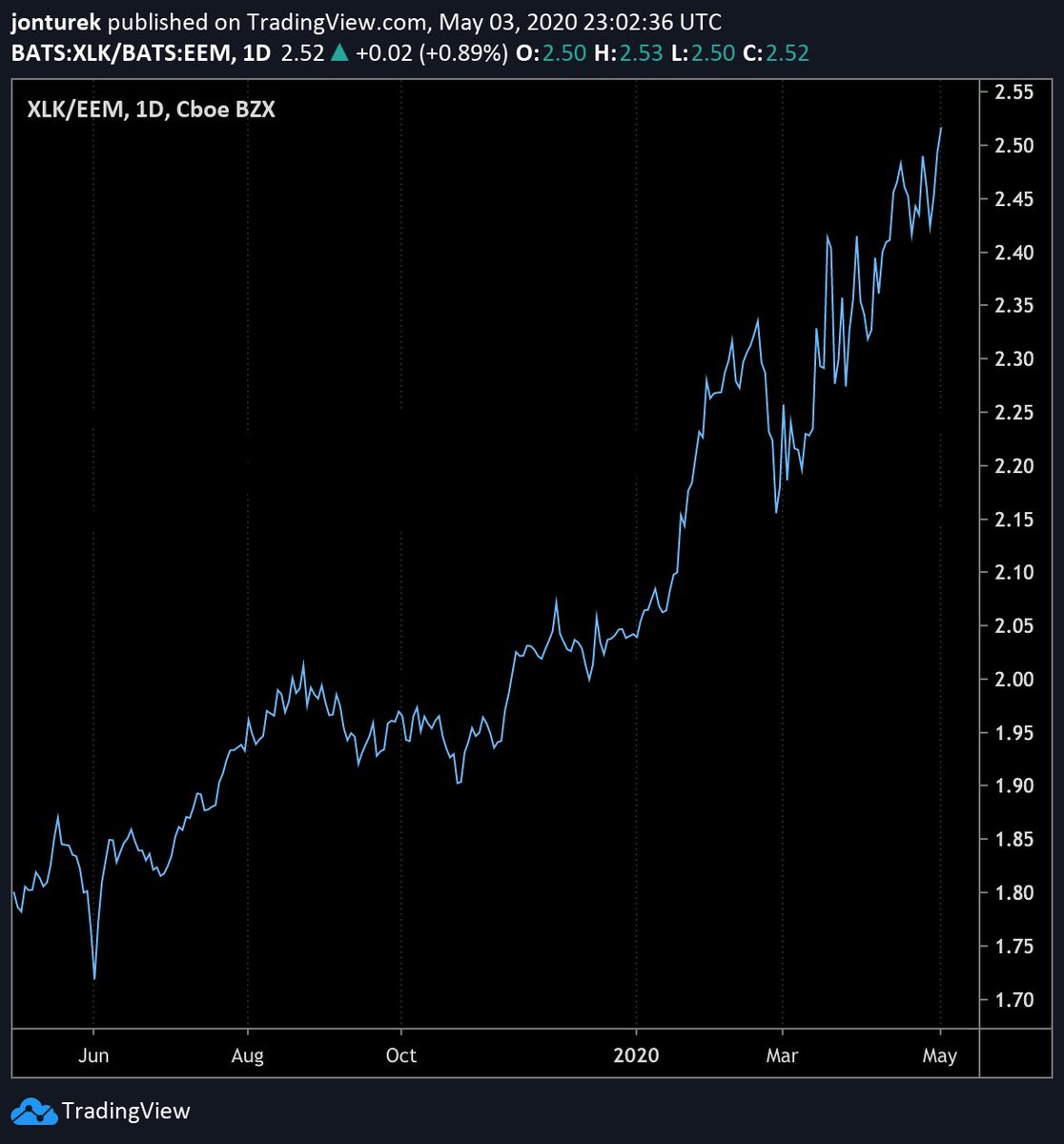
Overall: The combination of this dynamic, how economically regressive covid is, i.e. the poorer countries are more vulnerable, has set up this really interesting dynamic. My expression for this framework has been long tech short EM, or on twitter what I called the "cleanest chart in macro." The reality is, it plays on so many macro dynamics, from relative balance sheet capacity, distribution of economic outcomes, and capital flows in a global QE world.

Said in another way, I want be long "good" outcomes in US equities and "bad" outcomes in EMFX.

Tech v EM

Image

The other way I have been thinking about this framework is, being short reflation and being long the market is not at odds with each other. 


The European barbell, politics is a left tail

I have written a lot about a European barbell, an idea basically that Europe is at a key point and it basically has two options.

Two options:

1) The good one: some level of joint issuance either via mutualization or through commission bonds that allows for risk sharing among members. This would not only be crucial in terms of politics and solidarity but it would also provide the world a safe asset in a time of high demand for cash alternatives. This would be bullish EUR.

2) The not good outcome is, the northern countries don’t budge on some level of risk sharing and despite an aggressive ECB and a real backstop in the ESM, political backlash leads to fragmentation that the ECB will have a tricky time combatting. The point is, technicals aside, even with unconditionality, eurobonds and ESM are not interchangeable from a political perspective.

A muddle through might not work, the South has leverage this time

Another new dynamic this time is, the Italians have power and what if Italy throws a punch.

The creditor v debtor dynamic has changed, the periphery is no longer the "bad guy", that’s now the Northern countries and they don’t seem to get it. An exogenous shock has rocked the southern countries, one the Commission admitted to being late to, this isn't a situation where another round fiscal responsibility lectures will go over well.

This is a problem the market seems to be discounting. Of course within the distribution, the most likely outcome is some form of European muddle, as we have seen so far with the Commission recovery fund that does propose some grants. However, the difference this time is, not that a muddle wont work, but it may have tangibly negative political repercussions, and relatively soon. The political terms seem a lot more binary.

Mutualization type = support and solidarity, ESM type even with unconditionality = you don't care.

If Conte is going to try and sell the people on another classic pathchwork European backstop, this sets up a worrying development. Either the Italian government decide they do not want to sell this or they do and it is rejected via domestic political turmoil. I.e. if a bandaid is the European response, it could get pulled off pretty quickly.

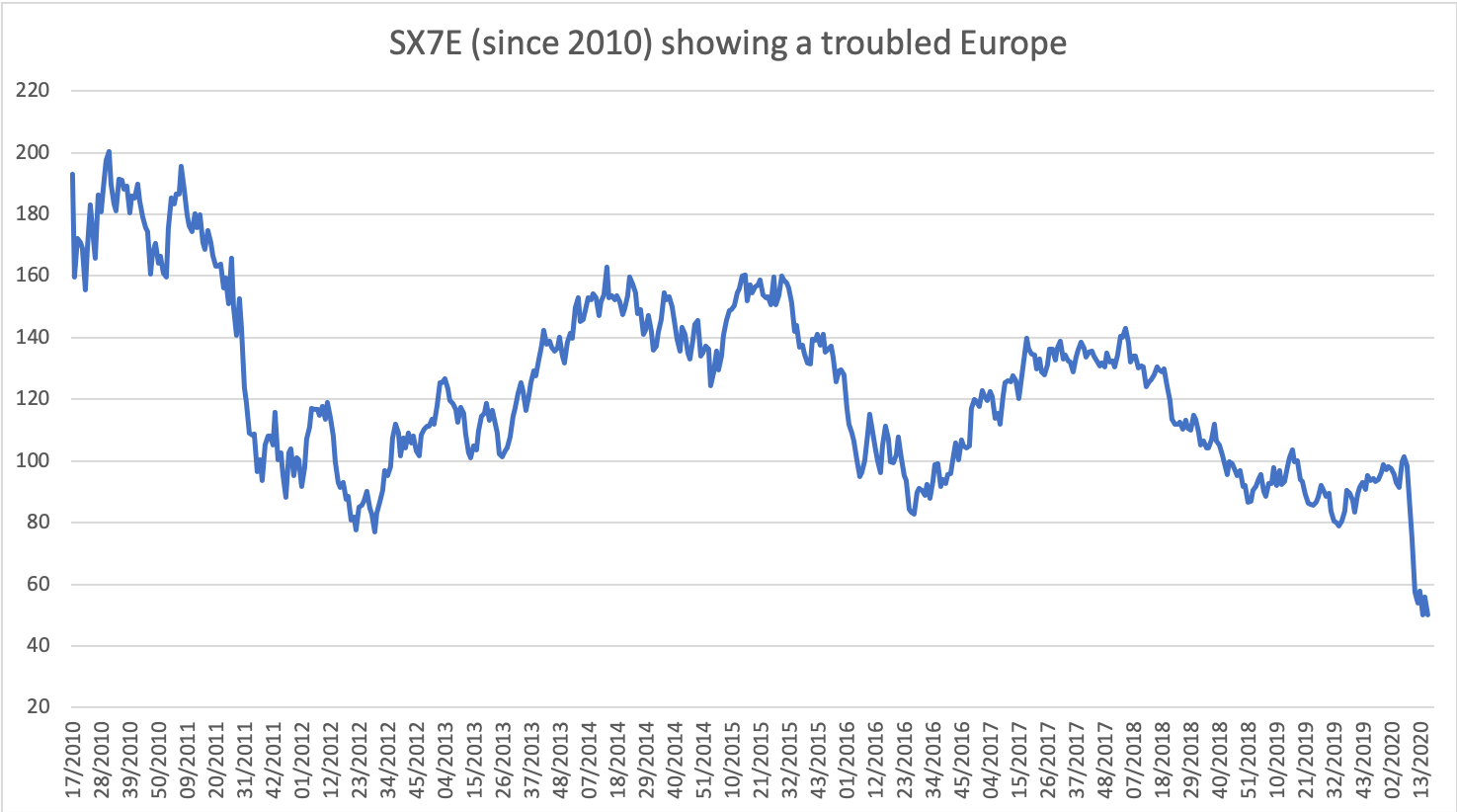
The question is, how do you bet on unfortunate outcomes in Europe. The currency is tricky because that surplus is such a floor in risk off. Despite asymmetry, BTPs are hard to short given the ECB bazooka with PEPP, that will likely get bigger. Sure Lagarde left a lot to be desired last week. but the ECB is there to tighten spreads and the market knows it. So there are two dynamics, there is a tail in Europe that is still likely underpriced, but given structural dynamics within the EMU (current account and APP) its not clean to bet it. The answer may be short CEE FX, short EMU beta.

CHFPLN daily chart (LHS). GBPCZK monthly with 5y moving average (RHS).


Central European economies face a very precarious future, especially if the EMU is going to muddle through this. What is the CEE model. They get trade and funds from EU, it eats up domestic slack (tight immigration), raised rates relative to EMU (CZK), carry etc leads to recycling. The problem now is, the export car parts to Germany so that they can export cars to China, is not an ideal economic model. Since 2002, Poland/Czech/Hungary, have seen their nominal export levels rise by 2-4.2x. Integration has been a great trade for CEE.

As these globalization and global trade tailwinds have transitioned into headwinds, these currencies have to get fundamentally cheaper. And this all before their respective local political situations.


UK v Europe, long policy flexibility and short policy constraints.

I wrote last time why GBP is an interesting story. In theory, when UK eases, GBP gets killed because of current account, external debt etc. This time around, GBP has stayed relatively bid, even with one of the more aggressive monetary/fiscal mixes. The thesis I presented last time was that the market could be “rewarding” the UK for being less constrained than say Europe, which gives it a sort of 1931 feel in terms of the UK breaking free of policy constraints.

UK stocks v France (EWQ) & Italy (EWI), some interesting weekly moving averages.


Yen with a Fed backstop, a "free" claim on US assets.

There are a few interesting dynamics within JPY right now:

1) The Fed helped out GPIF. Dollar liquidity has allowed to them fund/hedge and Fed's backstop of IG has protected their positions. Fed will keep bills-ois in tact and try and prevent it from spilling into unsecured markets. This has been the pressure point for Yen and the Fed is on top of it. As long as BoJ is getting liquidity to end users, the pension/lifer sector, JPY should avoid another flare up.

2) Without technical dislocations in FX swap market, is Japan's NIIP position just a "risk free" claim on US asset prices. Now, especially if the Fed does YCC, why would GPIF take more naked FX risk unless instructed to do so by the BoJ (stealth intervention).

3) Everyone is at lower bound, Japanese FX policy from MoF/BoJ was not designed for that.

The question for Japan now is, how do they weaken Yen. The original catalyst for Yen weakness into this crisis was, Japanese bank and non bank sectors have a ton of dollar funding needs, which has explained the massive BoJ take up of the Fed's swap line. But, given how interest rates everywhere have converged to zero and deflationary risks from the demand shock have lowered expected inflation, it is very hard for JPY to weaken.

Yen v surplus Asia could be an interesting dynamic, sort of a lag trade at this point. As we have documented, a lot of surplus Asia is similar to Japan in a NIIP sense. They have a ton of excess savings that overwhelms size of domestic market so needs to be exported. However, unlike Japan, none of these countries have made the painful export adjustment (Japan is still in it). Exports accounting for 50% of GDP is not the way of the future. So many of these Asian countries are in for an adjustment, likely a fiscal one. So yes, both Japan and surplus Asia have massive NIIP positions which should support FX valuations, but relative to Japan, many of them still have to make broader economic adjustments.

This chart is super interesting. JPYKRW.


Does the Phillips Curve matter if income has been replaced?

This is a bit wonky but it fits into my framework for that reflation and rising asset prices are not the same thing. The question is, why has deflation been ruled out.

Few potential reasons:

1) Even if the Phillips Curve is alive, the income channel has been replaced via stimulus. Goldman did a great chart documenting that as a first order shock absorber to spending, stimulus has prevented a disaster in incomes.

2) It didn't happen in 2009. The new Keynesian model told to us to look through current slack. Future marginal costs matter more than current economic activity. I.e. there is this form of discounting which leads to stickiness. And that is why the a DSGE based on NKPC would not have forecasted deflation post GFC.

3) The most accepted reason in policy maker circles is, the flatness comes from a lack of variance in inflation given how successful monetary policy has been in anchoring expectations.

4) the price PC slope has flattened because both wages and prices are changed less often. Once variance decreases, stickiness increases and the response to changing labor market dynamics is smaller.

5) Empirical bias. As the unemployment rate got lower and lower, and past any SEP estimate of NAIRU, the conclusion from policy makers was, the price PC still lives, but the slope is just much flatter than we assumed.

What if policy makers are too confident the PC is dead or irrelevant given income replacement.....

Yes, a lack of variance in prices seemingly has become self fulfilling. But there seems to remain risks that we buried the Phillips Curve at the wrong time. Maybe, it's not dead, maybe it's just asymmetric. And yes, income has largely been replaced by stimulus this time around. But, there is still a lot of behavioral differences between someone who is employed v unemployed. Healthcare, risk aversion, expectations. I.e. you can replace income, but the impulse is fundamentally different.

This a rough example where you take average PC slope during two "best" years of recovery v two "worst" years of downturn. Plenty of problems with this approach, but does convey an interesting point that should be pretty intuitive. Of course, in these episodes the fiscal stabilizers were nowhere near as big as they are today.


This is why I am surprised the Fed has been relatively slow in changing its forward guidance that is far too delphic v ZLB risks. The current idea seems to be it is too early and the Fed at this point doesn't need to convince the market of much.

I think the right framework for where the Fed is going in this regard comes from Brainard's February speech. Her idea is that we should have aggressive outcome based forward guidance along with interest rate caps, creating what Brainard calls, "the commitment mechanism." This is really interesting because both of these policies have merit on their own, especially at the ZLB, but together, they kill two birds with one stone. Cap yields, strong odyssean guidance, and together they reinforce each-other. I think this the framework the Fed will adapt, whether at June SEP or Jackson Hole, but sooner than later. 


Monday, April 20, 2020

Global Macro Thoughts

A few thoughts on the current global macro environment:

- Europe needs to step up. A barbell strategy could be the best way to play it.

- GBP chart is really interesting, what if it contains a larger macro message.

- Single digit oil, inflation is tomorrows problem, it isn't todays.

- Fed is threading the needle to control USD, but it can't answer the demand side.


Europe needs to step up, a barbell strategy for EUR

"Whats at stake is the survival of the European project" - Emmanuel Macron

Without being too alarmist, it appears the EMU is at a key point in its history, and its response to date is insufficient, especially as it relates to its southern members. Europe has hit a fork in the road, provide a safe asset that at the same time assists the southern countries which conveys some sort of symmetry and commitment to the project, or don't, and face the political consequences.

The most recent meetings of European finance ministers was a chance for the northern European countries to really prove to the periphery that the project is worth it. One of the key things the north has to prove to the south, especially in a political context, is the idea symmetry. In terms of perception, the "transfer" has been, the north takes your productivity, and in return you get the north's borrowing rates. So when times are good, Italian productivity is turned into higher German property prices. However, it can be evened out that when an exogenous shock comes, one so big that is existential, the north says, you borrow where we borrow.

Unfortunately, that has not been the response to date. Instead, what the southern countries are seeing is, when times are good, the productivity transfer happens, and when things go wrong, the weakest among us go the ESM.

Europe has a chance to kill two birds with one stone, create a safe asset and prove the merits of the project to its most skeptical members. So far, they have dropped the ball.

The question is, is the ESM and joint issuance interchangeable, the answer as we know is no. Two key issues even if unconditionally has been agreed. First, stigma, and second, Italy has shoulder this debt load. So let's look a few years into the future, say 2022. Things have calmed down, the economy is back at operating around potential. Every six months, the Commission will give the Italians a hard time about their debt being +150% of GDP.

Eurobonds v ESM, comes down to a simple breakdown, even if technicals appear similar with unconditionality added. The point is a perception of political solidarity. Even with the disparity of unconditionality, the negative legacy still resonates and has the perception of treating them as second rate citizens. Europe will miss the forest for the trees if their message is that there is negligible difference between ESM unconditionally and a common issuance scheme.

The bottom line is, Italy thinks Europe was slow to respond to the health crisis when they needed help, which the president of the Commission has since apologized for, and now they are going to be perceived as not helping in a financial sense by forcing them to use the ESM. It is hard to see how there are not significant political consequences to this, especially as the voices who can convey this, already are on the Italian political scene and have a pretty powerful voice. According to domestic polls in Italy, confidence in European institutions has gone down in a month from 42% to 27%.

Europe can still save itself

One of the things that makes Europe so interesting right now is, the flip side of this, if it were to take place, is immensely bullish the EMU and the single currency. With one stone, Europe can solidify its project by extending an olive branch to the south and be a recipient of massive flows from reserve managers and a global savings pool that is desperate for cash like alternatives. The introduction of a safe asset in this environment would be met with massive demand, even from people outside the reserve manager community. Japan for example, is a massive buyer of OATs because the combination of PSPP and a lack of German/Dutch issuance have left OATs by themselves for reserve managers and Asian pensions.

It doesn't even necessarily have to be coronabonds. Vitor Constancio in a recent blog post put forth something interesting. He postulates that the Commission could issue debt under the context of Treaty Article 122.2 which states "Where a Member State is in difficulties or is seriously threatened with sever difficulties caused by natural disasters or exception occurrences beyond its control, the Council, on a proposal from the Commission, may grant under certain conditions, Union financial assistance to the Member state concerned." Either way, the point is, there are technical ways for Europe to have its cake and eat it too. Which is, northern countries not having to joint issue and southern countries would avoid the stigma and get relief. While the situation may be binary, the solutions are not.

If Europe were to invest itself, with the commensurate response this crisis requires, it could solidify the monetary union and encourage foreign flow from reserve managers and global savings. Hard to see how that wouldn't be immensely bullish EUR.

This duality is what sets up a barbell type strategy for Europe. Either they get it right, or they continue down this current path that surely leads to negative political consequences. Do joint issuance, save the EMU from political backlash and introduce a safe asset in time of tremendous demand for cash alternatives. Or, the market prices some nasty tails from the political backlash, which even Draghi in May 2018 struggled to deal with.


GBP in a world of fiscal/monetary mix, the post Osborne/Carney UK

One of the more interesting charts to me in global macro right now is a broad reading of GBP using effective exchange rates. Since Brexit it has been making a long basing formation.


Typically, in a crisis, GBP comes under pressure as it runs a large external account deficits with high external debt levels. However, despite its initial reaction in darker days of March, GBP has been resilient, even relatively strong. This comes with a very aggressive monetary/fiscal easing that has included a temporary reactivation of a scheme that makes it possible for the BoE to finance public spending directly. So the UK has gone into this shock with an overhang of political clouds from the transition talks with the EU, weak external account (c/a, NIIP, external debt) and has done the most aggressive version of monetization, and with all of that GBP/Gilts keep rallying......


It's absolutely possible that GBP is pricing spillovers from funding markets, and there is no massive GBP breakout coming. With that aside, there could be a broader macro point in GBP that is worth considering. It is possible that GBP is pricing, this aggressive policy mix, as "the right thing." I.e. what if this is the UK's 1931 and breaking the gold standard, which led to a few a years of higher TFP and higher real growth. There is no FX deval this time, but UK policy is being "set free" after years of fiscal austerity and defensive supply side based monetary policy making. 

What did every MPC inflation report say once the bank started hiking rates. "MPCs central projection, therefore, a small margin of excess demand emerges by late 2019 and builds thereafter, feeding through into higher growth in domestic costs than has been seen in recent years." The perception of reduced economic potential from Brexit led the BoE to a tighter posture than it needed to be. 

The UK has lost its Osborne/Carney combination of tight fiscal and hawkish monetary based on a shrinking supply side and has replaced it with an aggressive monetary/fiscal mix. The currency is usually not the outlet to represent such a transition (and maybe it's a poor way to play it), but it could be this time around as this transition seems very bullish, especially v the obvious constraints that Euro countries are facing. A currency is an outlet for economic imbalance. Aggressively trying put an economy back together in the name of preventing further deviations from potential, is not an imbalance, even if the numbers seem big. What if GBP is saying the UK economic response is right......

Short EURGBP seems compelling. UK policymaking have been set free, Europe is still constrained. 90c looks like a decent top and should serve as a good stop.


Oil is going to single digits, inflation is tomorrow's problem

The Saudis and Russian both knew there was no rebalancing the market into this sort of demand shock, and decided it was time put shale in the grave, and they are doing just that. Global demand is off somewhere between 20-30mbd, Cushing is likely to be close to filled up by the middle of May (inventories are rising at +16mbd per week), and rolling shut ins in the US/Canada will begin to take place.

This dynamic has set up the super contango in the oil futures curve, and with few bullets left from geopolitical forces, oil is still a compelling short. One, there is plenty of room for oil prices to continue to fall before shut ins really accelerate and once storage gets overwhelmed that is when you get negative prices in regional contracts as basis continues to be super wide. And because of this current storage dynamic, the market is paying you an absurd amount of carry to be short. The May roll has been absolutely hideous, but it seems like nearbys will continue to trade in steep contango with the just an absolutely vicious rolldown. So oil has no demand, storage is filling up and you basically need to make 20% just to beat the roll, how can anyone be long this thing and yet inflows into USO ETF continue and that is likely the only thing keeping up the June contract. These USO inflows are about to get killed. And they are the only reason the active June contract is still above 20 bucks.


So what are the consequences of single digit oil in a global macro sense. The first thing that comes to mind is the inflation question. I'm sympathetic to the inflationary endgame; disruptions from supply chain regionalization, public policy more focused people with higher MPCs. It is all very plausible, but it will take time.

Supply chains will face political pressure and a reevaluation of the trade off between the wage arbitrage and transportation logistics. But these things take time unless politics hastens the adjustment, which could very well happen.

However, the path to supply chain regionalization and more targeted public policy is with massive labor market slack, an oil price that is single digits and an increased propensity towards savings as covid19 leaves its economic PTSD. Despite massive public sector deficits, it is very hard to see how a massive imbalance between supply and demand in the aggregate will form in this backdrop, even if the supply chain disruptions are worse than many are projecting.

The trading consequences of $10 oil, a few things:

- Breakevens have gone too far. Stocks are not pricing some miracle recovery, as Mike Green in recent post said, the stock market more so represent transactions than information, and the combination of passive and massive foreign savings demand along with a liquidity bazooka all are colluding to raise asset valuations, even into uncertainty. Real yields will likely begin to rise again.

So far these two seem pretty correlated. That could continue, but may not make sense to read too much into the message. The economic imbalance is there is too much private capital going after too few investments, not that there is too much govt spending into too little economic supply.


- USDCAD could go to 1.50. Combination of an oil price in low single digits or even negative (WCS), and what will be a private sector balance sheet deleveraging should put a cap on how far an economic recovery will go. Also the BoC has been pretty aggressive themselves with cutting all the way down to its effective lower bound (0.25%) and doing three pretty big liquidity programs (BA purchase facility, Provincial Money Market Purchase Program, CP purchase program). That is all before they said at last weeks MPR meeting that they will take down 40% of each new gov't treasury bill auctions, and said they're program of purchasing gov't bonds (min 5b a week) could be increased any time. Canada went into this crisis with an economy near potential, as the BoC likes to point out, but it also went into with relatively high levels of household and private sector debt. The combination of a slower private sector response and very low oil prices all with an aggressive central bank could make CAD pretty vulnerable.

Controlling USD is like threading a needle, what about the demand side?

The market seems torn between two camps as it relates to USD, and it is quite binary. This is quite interesting as it seems like a very nuanced dynamic. And again, the demand side is likely being underestimated with not that many alternatives for capital to go. 

A few dynamics:

 If the battle for global savings is US risk assets v EM/Europe or China, US will likely win.

- Balance sheet constraints were a key reason for USD strength in the onset of the crisis as many Asian non bank financials use that balance sheet to hedge/fund USD credit risk. With the Fed flooding the market, local CBs more focused on reaching end users, its hard to see what really aggravates the FX swap market as cross currency basis will trade with a much less negative bias. The effect of UST bill issuance will probably be key in monitoring this. But as a whole, the Fed is getting USD to those who need it, and that could really serve as a cap on USD strength as it has so far. Especially if Zoltan is right and the Fed caps bill yields.

- So Asian savings has to worry less about funding/hedging duration trades, and the Fed is implicitly backstopping many of the instruments they are long, investment grade credit. That means the US is still a relatively attractive place for global savings, especially if this duality of a tame FX swap market, curvature which reduces hedging cost and a Fed determined to protect high quality risk assets, seems like USD is still a decent home for global savings.

- One of the key spillovers of QE is meant to be the portfolio balance channel. However this channel becomes a bit more confusing when everyone is doing it, i.e. no global carry trade. Is real money going to fund EM, seems unlikely, they have no growth and no carry.

Makes sense for US tech to continue to attract capital over Emerging markets. This trade plays on two themes:

1) DM has balance sheet to absorb this mess, EMs do not.

2) In a world of no carry, capital will prefer US given growing asset class in an appreciating currency.


- EM crisis response seems to be correct, but it will require a continued adjustment in the exchange rate. Even, if IMF liquidity facility and an SDR allocation were to come in a meaningful way, that will only give local CBs more room to continue cut rates. If the response remains underwhelming, then places like (ZAR/IDR/MXN) will continue to go through the "original sin redux" as Carstens and Shin have noted. That is the problem with having such a high percentage of your local ccy bond market being owned by foreigners. And, the cut rates/let fx go, doesn't actually incentivize a buildup of domestic savings.....

- So while oil and shutdowns will keep current account balances relatively in tact, as we have seen in places like the Philippines where the Luzon shut down has cut import demand to zero. This gives the BSP plenty of room to get dovish. However, what happens when it opens up, and remittances drop, PHP wont be as strong as it is now with the policy rate at 2.75%. The point is, as unfortunate as it is, this EM adjustment in the exchange rate will likely be structural and the bias will continue to be for USD/EM to trade higher.

No growth/no carry, this could be more structural.


- And as a last one in terms of where capital could go, as we said above, Europe is vulnerable.

Overall: yes, the Fed has done a lot to clean the global USD funding pipes, but it's hard for them to fight the fact that the US is still the preferred destination for foreign capital. And that at the end of the day will likely be the balancing act of USD going forward. My bias is that it goes higher, but the Fed could have established a pretty decent cap by dislodging the USD funding market through these massive liquidity injections.

One point that I think is overrated as a reason for pending USD weakness is the "twin deficit." This likely underestimates how much bigger deficits can get before they worry USD. Ito & McCauley from the BIS showed us that global imbalances look a lot different when key currencies are the unit of analysis and not GDP.


The world likely still lives in a USD smile world. Until a demand impulse from RoW is to emerge, the market will continue to focus on the risk on/off dynamic of how USD can benefit in either, higher risk assets or a flight to safety. I think a key answer in the USD, risk assets etc, will be found in global term premia. Either it rips in response to the massive size of this global easing impulse, or it lags and continues to favor the imperial circle, strong USD and elevated US asset prices.


Thanks for reading, stay safe, best way to be in touch is email, jonturek@gmail.com

Thursday, March 19, 2020

Fed Swap Lines, USD Shortage and a Policy Transmission Problem

Today the Fed made an excellent decision in expanding the list of CBs eligible to USD swap lines.  The point of this note is to try and clearly explain the issues in the current dollar shortage and why swap lines by themselves may need to be expanded in terms of definition because the actors are not the same they were in 2008. The USD funding market is 13t dollars according the BIS and it is under huge strain. Today's announcement of the Fed adding nine more CBs to the central bank swap line program is huge and will hopefully alleviate some of the issues below. As a side all the credit for this post goes to Brad Setser and Hyun Song Shin as they set the standard on these dollar issues and how they impact the real economy.

USD is the dominant global macroeconomic variable

To me, the dollar is the dominant macroeconomic variable. In terms of the financial and real economy, the dollar sets the pace. Right now there is this fascinating duality going on where the world in a binary sense is either extremely long USDs via lopsided international investment positions or extremely short them via credit intensive supply chains. The problem is, the world is not binary, it is incredibly nuanced. And what is making it worse is all these things cracked at once. And under the current reaction, the Fed seems to be reacting to old USD world not the one we live in now.

What has the dollar been saying in its reaction to covid19, and what stage are we in:

First reaction (end of February): USD is a risk currency via a massive negative NIIP positioned. As that flow into assets has roared, more and more of it was unhedged. This contributed to an imperial circle of sort which I have discussed in past posts. So what happened, risk markets started to get hit, new flow into US assets stopped and the dollar got sold.

Second reaction (early March): As the pandemic rolled on, supply chains, which were already stretched and vulnerable, began to break. What do we know about supply chains, they are incredibly credit intensive, especially the longer ones. The other thing we know about them, many of them fund in dollars. As they break, they hoard USD for payment and FX basis blows out and CIP deviation furthers. Which is when the Fed comes in with central bank swap lines.

Third reaction (where are now): Supply chains are breaking, Fed swap lines are not frequent enough in an operational sense and they don't reach far enough in terms of jurisdiction. The dollar shortage is becoming more amplified because key economies are left in the cold. The RBI did two yards of USDINR swaps, and 4b was on the bid. Global corps, especially ones that are part of long supply chains, are stretched and desperate for dollars. To make matters worse, there is a transmission problem in terms the Fed's swap lines. Outside of Japanese financial institutions, most of these players are non bank actors who need USD. This is another example of the Fed's liquidity transmission being broken, the problem is, the 13t dollar funding market is in trouble and it is mostly non banks which makes it harder to get them the support needed.

Before we go into the background, here is the conclusion: The Fed has more to do in terms of FX swap lines. There is a combination of supply chain weakness in EMEs and a misdiagnosis of the problem in terms of who actually uses the FX swap market. Since the crisis, it is mostly non banks hedging UST and US credit exposure. The Fed needs to go to the root of the dollar issue, and unlike 2008, it is no longer getting swap lines to the ECB to fix dollar mismatches in the European banking sector. Asian lifers and pension funds are now the massive players and they need much more directional help.

Two key actors and 13t dollar funding market.

1) Credit intensive supply chains

2) Non bank actors who are biggest players in FX swap market to hedge US credit risk

The point is, until today, the Fed was in no mans land re these CB swap lines. The supply chain pinch is in EM and the financials that use the FX swap market are no longer banks playing US mortgages, its non bank actors like Asian lifers and pensions that FX hedge US credit. Neither are getting the help they need. The transmission of these swap lines needs to be adjusted to further ensure effective policy transmission.

Part 1 of the Fed's problem, the 13t USD funding market 

There is an implicit loanable funds framework to this which may not make this so popular, but the basics of it is, USD cross border flows = RoW USD lending to global actors.

The problem global actors have is, this 13t dollar funding market is very fickle and as supply chains have become elongated, they have become more and more credit intensive. This sets up a two part problem for supply chains.

1) The level of the dollar effectively determines how much financing they can do. And as the BIS has explained, this sets off a bit of a doom loop. When there is a credit crunch for these actors because the shadow price of credit is rising, output falls off, which only strengthens the dollar (less economic beta to exports than RoW), and this fire can only be put out by the Fed.


2) When the dollar goes up, financial conditions freeze which only amplifies their need for USD. An example of how bad it is was in India this week. RBI did a 2yard auction in which there was over 4b on the bid. Korea is another example, BoK did a large intervention last night selling USD v KRW and spot rate still went up 2%, only to be arrested by the Fed announcing a swap line to them this morning. These guys are outmatched without Fed/IMF help.


BIS has done amazing work explaining what are the key parts of the 13t USD funding market.

1) The broad dollar effectively shows us dollar funding conditions in the global economy.

2) As Hyun Song Shin has explained, it is also an indicator of bank balance sheet capacity via VaR. Assume the counterfactual to make this point more clear.

"If a global has a diversified portfolio of loans to borrowers around the world, a broad-based depreciation of the dollar results in lower tail risk in the bank credit portfolio and a relaxation of the banks VaR constrain. The result is an expansion in the supply of the dollar credit, through increased leverage."

The point is: if a weakening dollar can expand bank capacity to lend, a stronger dollar does the inverse of that and tightens capacity.

These two things are what connect the level of the dollar to the real economy. As I've said in prior posts, the dollar is a culprit and a reflection about the level of global GDP. On the hand it can impose weakness via shadow credit, and at the same time it can reflect the weakness in global trade and supply chains via a lower beta to global growth. This is the result of a currency that is 50% of global trade invoicing and is only 18% of global GDP. This mismatch between USD representation in terms of US contribution to global GDP and its global usage is only further evidence of how important the Fed is outside of their domestic mandate when the world is in crisis.


Part 2, the non bank financial actors that run the FX swap market

Something I have gone into over the past few weeks, is that Asian demand for USD assets has been relentless since the crisis. So big that it has ballooned into $8t international investment position for Asia. The reason has been relatively simple, it is capacity. Asian real money assets are over 10x the size of their domestic IG market with the Japan the extreme at over 20x. Add on the fact that it was positive carry, and the money flew into finance US deficits, especially in the private sector.

In a prior post I focused on the unhedged aspect of this trade, especially as it relates to Taiwanese life insurance companies. And while that is still an issue, when liquidity dries up the issue expands to the hedged aspect, especially as these guys hedge in the front end to own longer term USD assets.

So what happens when there is a crisis, over 11% of demand for US credit goes quiet (outside of stealth GPIF interventions). And this amplifies the liquidity crisis onshore. The problem is, swap lines go to banks, and the biggest players this time around are non bank actors. And these non bank actors are so big that when they have issues, it is felt in illiquidity onshore. For many of these guys, liquidity in the global money markets = capital market liquidity onshore in the US! So the Fed needs to get liquidity to these guys in order to help restore second and third order liquidity.

This is the importance of transmission. Dollar auctions are nice, but the non bank actors need access to them. If the Fed can arrest pressure here, that will be job done and the positive ramifications will spillover into things they definitely care about, like liquidity in US credit and treasury market.

This is why the FX basis market and the broad dollar index have shown such a strong correlation.


What will the Fed final reaction be, what are the key characteristics of this USD shortage?

I can't underestimate how big today's move is and I applaud the Fed for doing it, it is very necessary. My only fear now is, is not only that this list of 16 CBs is still not long enough, but that the transmission is much more complicated this time around, as supply chains are much more in EMs and the biggest player in FX swap market these days are not banks, its non bank players.

So what are the key characteristics of this shortage

- Within foreign banks, its not homogenous among who funds in USD. Canada and Japan, are not in the same boat as Europe for example.

- The biggest players in the FX swap market are not banks anymore, its non bank actors who use it to hedge longer duration USD exposure.

- Supply chains are breaking and they are more often situated across EM's and EM CBs are being overwhelmed by local demand and massive portfolio outflow. Also EM CBs this time have decided it is better for FX to fall apart than to hike rates.

- Real yields are spiking as they are everywhere

- Oil is making it worse, petro dollar players are in trouble as oil players are all in USD.

Conclusion: The Fed has two key things to do after today's necessary decision. 

1) Make sure transmission of swap lines is working, it is harder in this crisis because banks are not the main problem. Non bank actors are that big now, and they can exert pain in liquidity terms in far reaching ways, which is effectively what we've seen.

2) EM's need help now. The Fed and the IMF need go past the 16 CBs currently on USD swap lines. This problem is only amplified as EMs are not hiking rates this time around as they are letting exchange rates be the punching bag.

best way to be in touch is jonturek@gmail.com