Wednesday, September 9, 2020

Stabilization to Accommodation, Brainard's Policy Transition

Sections

- Jackson Hole, the Fed’s current duality.

- Can we have a “beautiful” recovery or is fiscal in trouble?

- What if we have the USDJPY question all wrong?

- Lane's EURUSD comments were no faux pas.

Overall: One of the more interesting things going into the September ECB/FOMC meetings and the updated staff macro forecasts is they both have very important questions to answer. The ECB has to answer the EURUSD question, does 1.20 really bother them? The Fed will have to show what they can do to further ease given the SEP will continue to show them coming up short of their dual mandate goals. We know what they will do (won't do) when things get better, what can they do if things get worse? 

The Fed's duality

With the culmination of their strategic review, the Fed showed the interesting duality they find themselves in. On the one hand, it is clear the Fed will not be preemptively hiking rates in this new framework, something we have known since they initiated this review in 2019.

The Fed wants to allow the economy to recover and accentuate that recovery by remaining accommodative for longer than it traditionally has. That is of course dovish. And despite some missteps in the communique with regard to what exactly inflation overshoots will look like, the bigger message should not get lost, they will be allowing inflation overshoots and FAIT is the end of the “bygone” era.

However, this sets up two camps for the Fed going into the post covid recovery.

On the one hand, if this Fed backdrop is accompanied by a continued substantial fiscal response and an inevitable vaccine, it is rocket fuel for risk assets. As we saw in Brainard's July speech, the Fed's degree of monetary accommodation will expand with the recovery. That is when forward guidance is so powerful.

On the other hand, a problem the Fed has right now is especially in regard to this framework, they are fiscal dependent in terms of creating the conditions they desire in an outcome sense. By itself, despite opening up policy space with the balance sheet and forward guidance, the Fed will struggle to generate "good" economic outcomes on their own given the lower bound constraint. As Brainard effectively put it in her July speech, the Fed is very capable in preventing left tail outcomes via their balance sheet, however in terms of "accommodation" that will largely come in a pro-cyclical fashion given the lower bound constraint.

One of the things that Bernanke noted in his January AEA speech, L4L (lower for longer) policies can only do so much if neutral rates are below 2%. And this is where the Fed likely finds themselves.

“if the nominal neutral rate is much lower than 2%, then model simulations imply that new monetary tools while still providing valuable policy space can no longer fully compensate for the effects of the lower bound.”

If neutral rates are too low, L4L can't overcome ELB by itself most of the time.


*the QE options vary by size, B being the smallest, D the biggest.

So, this is how the duality presents itself. The Fed's new framework is incredibly constructive to an economic recovery, but by itself cannot create that recovery given the lower bound constraint. And while L4L policies will help, they cannot overcome ELB by themselves as they likely could in a higher neutral rate world. The Fed will try to answer questions on their easing constraints at the September meeting. This will be an especially powerful moment as it will likely coincide with continued fiscal impasse and an SEP (staff economic projections) that shows the Fed below their dual mandate goals for the duration of the forecast horizon.

All roads lead to the Fed trying to prove themselves again in September. We know how they will act, or not act, when times get better, what will they do if things get worse…. They will have to answer that question, or at least try.

Can the Fed keep getting this chart to bull steepen?


Can we have a “beautiful” recovery?

This is a bit of a play on Mohamed El-Erian’s/Ray Dalio's “beautiful deleveraging” concept from a few years ago. 

One of the more interesting under the radar aspects of this years Symposium was, Kristin Forbes of MIT and ex BoE, as chair of the second day conversations, had one overlapping question for all her panels: what is the hypothetical policy response to a right tail outcome in 2021? Let’s say there is an effective and widely distributed vaccine in Q1 2021, pent up demand is met with the combination of supply shocks and pricing power, how does policy respond? What if fiscal support has changed the calculus for hysteresis in the next cycle? As one could have guessed, there was no answer. Governor Bailey of the BoE basically laughed it off. The reason being, policy makers are assuming a post GFC recovery of low NGDP for their entire forecast horizon. And despite a substantial rally in headline risk assets, the market generally agrees.

The market seems to be entertaining a pretty striking inconsistency. One that I think is captured by the relative divergence between the weakness in the dollar and cyclical beta. The market is seemingly having no problem entertaining an 85 or 80 DXY world, but rates will stay where they are forever, tech will outperform everything and NGDP is still dead. Given all the body of work on how big of a multiplier the $ is on the global economic cycle, surely this can’t be. In fact, as the chart below shows, neutral interest rates and the dollar have had a pretty strong relationship going back to the GFC. The dollar can open up new economic outcomes given its strong multiplier effects such as credit, invoicing etc.

G4 avg r* LW model (inv) v USD REER pre Covid


So far, the market has traded the very positive dynamic that the dollar is a “solved problem”, i.e. its skew is no longer violently higher. However, what if the dollar was to really fall 2017 style in rate of change terms, that's a game changer for the global economy and changes the growth/inflation dynamic going forward. 10y breakevens will not be 1.80 in an 80 DXY world.

The big question now is, will the market transition from removing left tail risk premium to pricing in right tail outcomes in terms of growth and inflation? Was this just a mean reversion in terms of left tails leaving the distribution, deflation, Euro fragmentation risk etc. or, is the market beginning to entertain a new regime of fiscal permanence and a faster global economic recovery? In theory we could define the move in breakevens as simply mean reversion. Take what’s priced in caps/floors on inflation swaps, the composition of the move is in that inflation will *certainly be above 1%, but very little of the move is in the possibility that inflation will be significantly above 2%.

With this in mind, we enter three possible camps for the market and inflation right now:

1) The current camp, deflation is off the table, but this will still be a slow recovery, so ED strip stays flat like the dots. Risk assets get benefit of mean reverting data and zero discount rates forever. In that world, duration acts as a vacuum for equity risk premium and the long tech v everything else trade continues to work despite technical hiccups. 

2) The second potential camp, fiscal inaction leads markets to at least challenge the idea of a fiscal put and successful policy handoff from monetary. As Coeure always warned us, fiscal lacks "agility." Shorter term liquidity concerns turn into longer term solvency ones again and risk premium shoots up. This risk has been largely put down in places like Europe, as Germany has extended their furlough scheme until the end of 2021. However, it’s hard to say in the US it is off the table.

3) The third camp, the new world of fiscal is here. Aggressive fiscal policy leads markets down a much swifter recovery path, and we begin to question what if neutral rates won’t be 0 forever. This is the world where fiscal transitions from an economic backstop to an economic accelerant. This world is becoming easier to imagine. It is perfectly in the realm of possibilities that the US has an effective and widely available vaccine in Q1 2021 into a new democratic mandate that passes a +$3T HEROs bill. 

It is very possible that both tails are underpriced at the moment. The market is fully priced under the assumption that fiscal/monetary will be big enough to to cap any downside risks but not too big to create inflationary pressures. While that is the most likely outcome, it is a very tight distribution for a policy set that we really don't know much about. 

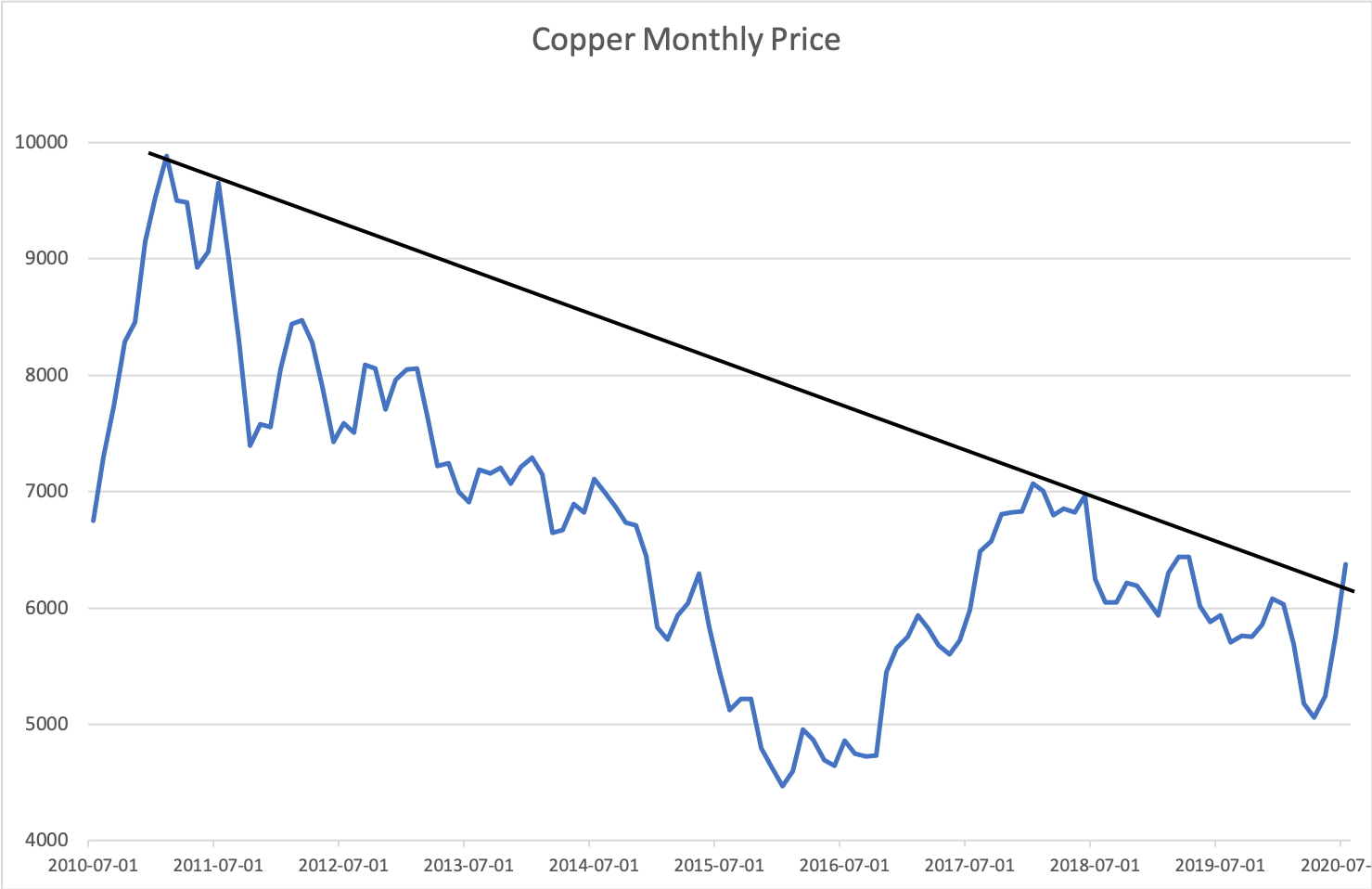
Copper may be evidence of the third camp is gaining steam


Does the market have the USDJPY question wrong?

One of the emerging questions in global macro these days is when does USDJPY breakdown and follow the broad dollar index lower. So far, USDJPY has been in a tight range due to very loose funding markets on the one hand and real money flows capping Yen strength on the other. And Yen is not going to trade on relative real rates. The question is, when does this tight range break and do we get this sort of inverse Abenomics move where USDJPY goes back to the 80s?

It's possible the market is asking the wrong question. The right question may be, what if USDJPY is able to absorb these weak dollar pressures and stay above 100, maybe even in this tight 105 range? Let’s say in a world of reflation, rising asset prices and flat term structures, Japanese policymakers are able to get what they want and effectively pin the Yen. That world is a very interesting world for Japanese stocks which are close to pressing up against multiyear resistance.

Nikkei 24k is a huge level if we get there. 3y daily chart. 


This may not be actionable right now, but it is something worth watching. Of course, it is too soon to say that USDJPY won’t follow this dollar move lower and that will pose a challenge to Japanese equities, especially in a relative sense. However, given the asymmetry, it is likely worth asking the question of, let’s say we are in a durable reflation and the BoJ has figured out a way to peg JPY, that is about as constructive as it gets for Japanese equities in zero rate world. All of this is happening at close to very interesting technical levels.

Keep an eye on the ECB this week

It was a bit surprising to hear comments from Phillip Lane last week re the current level of EURUSD. It wasn’t anything drastic, and the blog posts from Schnabel have not been particularly worried re the level of the exchange rate.

“At the moment I am not worrying too much about exchange rate developments.”

However, nothing is by accident with Lane, and he wanted it out there that the EURUSD rate matters and the ECB is watching it.

This sets up two questions:

1) Lets for a second entertain the idea that +1.20 worries the ECB. This is something I am not convinced of as the ECB knows the combination of fiscal and the nature of the shock have changed the pass through dynamics. However, in this hypothetical, they care. What do they do? The street is expecting an upsized PEPP, and that makes sense. In theory, QE is two birds with one stone for the ECB, it decreases fragmentation risk and lowers the XR (exchange rate). The problem is, in practice it won’t weaken XR and I think the ECB is well aware of that. The traditional portfolio balance channel ala 2014 is broken. Upsizing PEPP has a much bigger impact on left tail pricing/accommodating fiscal than it does on the portfolio balance channel, so QE in Europe could actually be XR positive…..

Marginal QE effects have changed since Draghi started PSPP


2) Is Lagarde going to entertain rate cuts? This is something that should be off the table, and it likely won't happen because it EURUSD 1.20 is an overrated risk for EA inflation. However, it would be very interesting if Lagarde makes a nudge at getting negative term premium to go a bit further. I.e. testing that lever and see what it does to EUR. And of course, because of that most recent inflation print, she has every right to do so. The knock on if the ECB starts to push the market a bit on getting serious re DFR cuts would be huge. This would open up the same problems of 2019, where the ECB via pushing the dollar higher ends up being a duration vacuum and broadly negative risk. Also, in a more structural sense, it threatens this new world of ELB + fiscal which has been $ negative. It is a much more positive risk FX environment when the only CB really entertaining cuts is NZD and we push the policy handoff narrative. ECB entertaining cuts would threaten that so it is worth watching even if it’s a small probability. As noted above, the $ is the key outlet for a global recovery and the ECB should not want to get in the way of that.


@jturek18

Wednesday, July 22, 2020

Macro in a World of Policy Omnipotence

The one trade now in global macro is, can policymakers continue to get whatever outcomes they want.

Sections:

- For the market, skew has mattered more than expectations

- Macro in a world of policy omnipotence

- The last idiosyncratic rates trade, China

- Is the JGB curve ironically the best DM steepener

For the market, skew has mattered more than expectations

One of the things that has seemingly been missed in this market is, the narrative has been focused on outcomes while the market has been pricing skew. I think over the past few months there have been a few examples of this.

- EUCO recovery fund. The narrative at the beginning of the process after the M&M press conference on May 18th, the size is not big enough. What has the market reaction been? the precedent of European fiscal transfers is a far more important development than the actual size of the recovery fund. As we have learned in Europe, it is harder to start something than to make it bigger, ask Mario Draghi.

- In the US, fiscal stimulus was supposed to struggle to cap the revenue drop caused by the unprecedented nature of this crisis. To an extent, it has, but what this narrative missed in a distributional sense is, the policy response to deflationary shocks has changed and the left tail has been clipped. The government sends out money and the central bank does open ended QE. Does this mean future growth is promised, no, but it does change the recession landscape in terms of size and duration.

- The US dollar is another example of this. How was the Fed going to downstream dollars to EM corps and Asian non banks. And then from there, was there really going to be a change in global growth composition that would change the USD "smile" world where US asset outperformance continues in perpetuity. Would previously frugal surplus countries step up with ambitious fiscal plans that would not only plug the covid hole but transcend the current crisis and serve as an economic accelerant going forward. The immediate answer to a lot of these questions was, the most probable outcome is no, but the market traded the skew and thats where we are today.

Going forward, I'm not sure what changes the current risk dynamic. I think a very interesting dynamic has been the fact that a weak dollar has not elicited a response from the long end of the US bond market. This may speak to the asymmetry we see in the current relationship. When the dollar is strong it weighs on global NGDP and thus term premium. When the dollar is weaker, FX basis tightens, and it again makes sense for foreign real money to buy the long end FX hedged to get a yield pickup over its local government bond equivalent. This latter dynamic is like rocket fuel for risk assets, especially EM, as all the stimulative effects of a weaker dollar, trade finance etc. can happen without a commensurate move up in term premium. This is the dream for EM. The question now is, after a pretty substantial move lower in the dollar, does it make sense to have some tactical stuff against core positions that have a risk bias. I think the places to look for this sort of exposure is CBs that have already said they don't want further FX appreciation (ILS, THB, TWD).

Macro in a world of policy omnipotence 

One of the more amazing transitions in markets since March has been the market's outlook towards policy. In the darker days of March, the Fed was "constrained" by the effective lower bound and fiscal was too slow. So the bet was, this shock would overwhelm policy. Fast forward to now, and the market has basically said no shock is too big for policy makers and if that is the case, we just gravitate towards the right side of the risk distribution as the policy put is struck so high.

Where we are now is, the market asks itself what the Fed wants and then puts those trades on. What are those trade:

- The Fed wants a weaker dollar. They turned every world government bond market into USD to prove that.

- The Fed wants IG to trade at new tights. Allowed record IG issuance three months in a row. Liquidity that prevents solvency issues.

- The Fed wants risk assets higher to ensure smooth financial market functioning for the real economy.

- The Fed wants real yields to plummet which effectively allows their easing footprint to expand with improvements in the outlook. Pro cyclical policy.

We are now in the market cycle of, the Fed can do what it wants, so the only thing to figure is what it wants to do.

The next stage of this understanding is in Brainard's speech from last week. The theme of that speech was the transition from "stabilization to accommodation". But I will translate that differently: we got nominal yields where we want them, now the policy focus is on real yields.

A key theme in the speech was this transition of, "stabilization to accommodation." What does that look like. Well, we know from pre covid, at the ZLB, Brainard was in favor of using ycc to reinforce forward guidance. However, "stabilization to accommodation" has further consequences. This theme of transition is right out of the Benoit Coeure playbook. During the stabilization period, what is important, as Coeure put it, is for the central bank to "put its money where its mouth is." QE plays outsized role and has a higher multiplier. Then the transition happens, to accommodation. QE multiplier falls as policy has succeeded in shifting upwards the distribution of risks around the growth outlook. This is when strong odyssean or outcome based forward guidance is most efficacious and asset purchases serve as reinforcement for forward guidance. “As the outlook improves, the signal that asset purchases send regarding the likely date of a first rate hike becomes increasingly important for anchoring the medium to long-term segment of the curve.” This is where the Fed is: they have cutoff the mechanism in which good news is priced into any part of the yield curve and they plan on reinforcing that, whether that is outcome based forward guidance with curve caps or not, I'm not sure it will matter. The market already knows. The Fed’s policy goal is to prevent bad things and accentuate good things.

So the skew for real yields is still towards going further negative. A few things:

- The market has transitioned from thinking policy can't respond to this size of a shock, to where it is now, policy can do anything. Betting on rising real yields is basically a bet policy is outmatched versus the size of the shock. That has been the wrong bet.

- Assuming my previous note about the dollar being a solved problem is in the ballpark, the chances of a runaway dollar clogging up the financial plumbing and constricting trade finance again has been severely reduced.

- The traditional Phillips Curve is dead. Maybe the New Keynesians have it right (marginal cost driven as opposed to slack). In fairness, they did tell us to look through current slack. Future marginal costs matter more than current economic activity. I.e. there is this form of discounting which leads to stickiness. But either way, in a world that policy makers are going to be expected to replace lost incomes, the distribution of potential economic outcomes is changed.

One of the things that weighed so heavily on bonds and breakevens in the prior decade was the asymmetry of deflation. When the economy was doing well, inflation did nothing, so imagine what would happen in a recession. That skew has fundamentally changed in a world where lost income is replaced to a certain extent and recoveries are unencumbered by premature stimulus withdrawals.

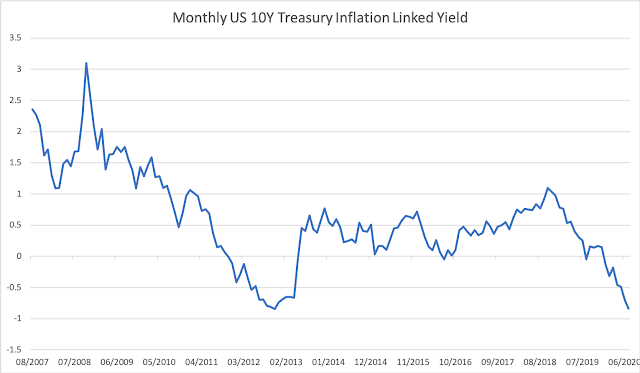
I'm not sure what stops this chart unless the market is to reevaluate its views on USD. Real yields and precious metals by extension are a just bet on continued policy omnipotence.


The last idiosyncratic rates trade, China

One of the more interesting and frustrating government bond markets in the world has been China. Yields in China seem to be the only place where the market is taking the "V" seriously. And when it comes to things like TSF (total social financing) and industrial production in China, it has been pretty "V" like. To add to this, China following the NPC let rip a special CGB issuance which the NPC fast tracked. Without a big RRR cut and other liquidity measures from the PBoC which were evidently absent, it zapped all the liquidity from the market and yields backed up a lot and the fixing rate from 1.5% to over 2.2%.

The question now is, are Chinese rates the place to receive and get some counter risk exposure. I have been burned on this trade before, but in terms of asymmetry, it ticks all the boxes. The Chinese "V" in industrial activity is more than priced and TSF numbers have likely made policy makers a bit nervous which could see the Q3 numbers come down. And finally, the PBoC is now adding a lot of liquidity even if it is not cutting rates such as the MLF or OMO. Since last week, the net injection of reverse repos has been over 230b RMB. To me, at a minimum this is policy makers saying, rates have gone far enough. And if that is the case, you get some negative equity correlation with a good risk reward.

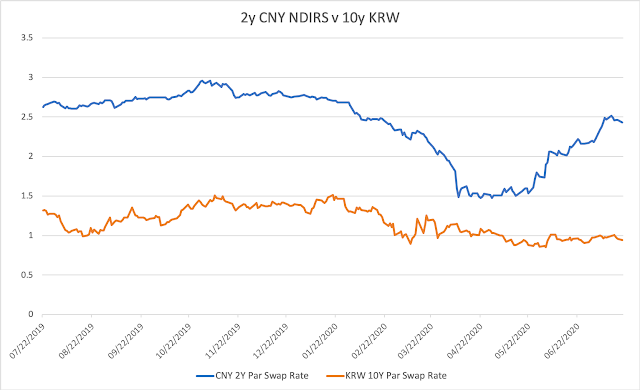
A trade I am really interested in is a cross currency steepener with Korea. Basically the idea is, if Chinese industrial activity is again leading the global economy out of covid, then the backend of Korea should begin to reflect that. So if this is a China led reflation, 10y KRW below 1% is probably wrong. On the flip side, in risk off, Chinese 2y above the fixing rate will move a lot. The point of this trade is, you are vol-adjusted received, and in case reflation goes into third gear, you're paid some duration and hoping the front end of China still sticks towards the fixing.


Is the JGB curve ironically the best DM steepener? 

Not so many people spend much time on JGBs anymore, and probably for good reason, it's barely a market at this point. With that said, there seem to be a few interesting parts to the market, especially given the external backdrop.

Going back at least a year, in the very front end (tbills) and the very long end, there has been a lot of interesting things going in JGBs, even if YCC has crushed everything in between

- In the long end, the BoJ has not been shy about encouraging steepness in the name of financial stability. This has been clear in FSR's (financial system report) and Rinban schedules of long end purchases. The BoJ is firmly aware that too flat of a curve is a problem for its bank/saving heavy economy. Throw on covid and budget blowout after at least two supplementary budgets, it makes sense the curve has steepened quite a lot, especially in the back end.


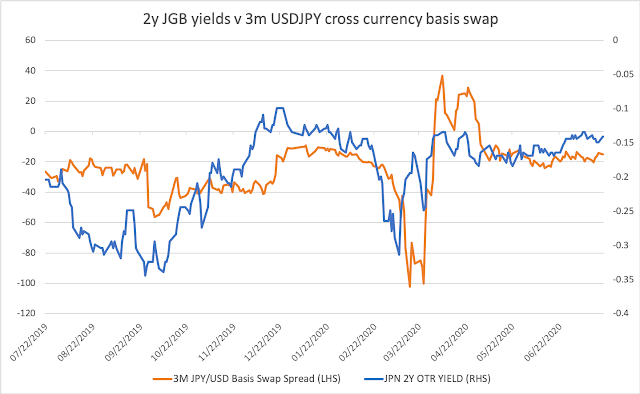
- In the short end, something else has been going on over the past couple years ago and it explains why foreign ownership of JGBs has soared. Basically, as Japan was one of the biggest users in the FX swap market in terms of funding/hedging USD, its cross currency basis swap spread traded very negative. Because of this dynamic, money would come into the FX swap market to take advantage of this very negative spread. What happens is, money comes in to take the other side of Japanese lifer/pension money looking for USD, usually at 3m point. Lifers would swap Yen for USD, to either US banks or reserve managers sitting on USD. Now, with all that Yen, these players would then buy Japanese tbills, which because of the negative xccy created a massive yield pickup over equivalent treasuries or bunds. However, given where FX basis trades now, the Japanese carry trade is a bit less compelling.


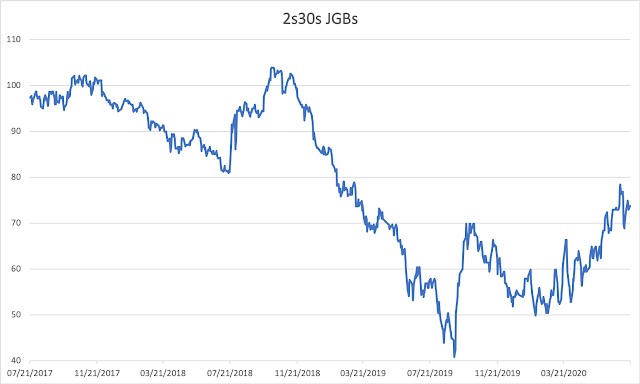
This dynamic could set Japan up to actually be the most asymmetric steepener out there. What we have seen so far is, as it relates to DM curves is, anything with carry and rolldown gets taken in, which explains the foreign bid in ACGBs. However, the background of that is, if FX basis is normalized, Japan can go back to getting foreign hedged yield pickup abroad, which will weigh on the long end in JGBs. Basically the point of this is, 2s30s Japan is being encouraged to steepen by both policy makers and dynamics within the financial plumbing. It can't go forever, but Japan may ironically be the place to steepen.

Japan more so than anyone else explicitly wants steepness in the curve and some of the technical backdrops may go to reinforce that bias. Of course there will be cuteness with overseas buying of JGBs on asset swap to take advantage, but the bias of the long end of the curve is to steepen and Kuroda wants the same thing.

@jturek18, jonturek@gmail.com

Monday, June 22, 2020

What if the Dollar is a "Solved" Problem

Sections: 

- Markets in two times frames

- Is the dollar a solved problem

- Relative FX vols, change in regime

- A lot is happening in China, what if CNH strengthens

Markets in two time frames

One of the things that is very interesting to me at the moment is, the current macro risk setup seems to be occurring over two different time horizons. Yes, markets are bid again, but really spoos have been stuck in the 3100-3120 area for the past week now.

In the near term, the macro setup seems to have a few headwinds. Reintroduction of mitigation measures in Beijing, rising positive test rates across the south/west in the US, rising possibilities of W's across many high frequency indicators and pending fiscal cliffs most notably in the US.

However, over the longer term, there are some very bullish things happening. One, the dollar is appearing to look like a solved problem (will further explain this below), at a minimum, the Fed has nipped the $ feedback loop in the butt. Second, the European recovery fund is not perfect but it is a paradigm shift in terms of fiscal transfers and expands fiscal scope for the periphery. Third, it seems like there will be a vaccine, and with the discount rate at 0, the waiting game is doable. And lastly, maybe most importantly, the global economy's fiscal posture looks like it could outlast covid, which either changes the distribution in terms of pricing demand shocks, or best case, leads to a bit of a demand side revolution where governments transition from economic cushions to economic accelerants. Either way, the skew is positive.

With that said, the path there will be messy and likely will entail multiple retests. In terms of equities, one of those levels that has been of great interest to me recently has been 2950 area in S&Ps. That is where, the rally shifted from tech led to cyclicals led. Now, as the rise in new cases accelerates and some of the promising high frequency data appears to be showing signs of rolling over, tech has reestablished itself as the leader of this rally. If we stay in this current environment, especially with a fairly nasty quarterly rebal on the horizon at month end, S&Ps should be biased lower over the next few weeks. After that, the debate in price action returns to, how long will this fiscal impulse be with us. If it is temporary, tech by itself can keep the major averages fairly elevated, likely above 2850 in S&Ps. However if this fiscal impulse will transcend covid, multiples look a lot less scary and equity risk premia will continue to be taken in. To me, the balance of risks is, going into potentially slowing high frequency data and fiscal cliffs (end of July), the market will have a tough time absorbing quarter end, however, once the fiscal impulse globally is clearer and sustainable, the market will have little trouble discounting a turbulent fall in terms of the virus.

Is the dollar a solved problem? 

I want to preface this section by saying, this is not an all clear on selling the dollar. However, there is something very interesting about the dollar backdrop that could have massive global economic implications. The question for the dollar has shifted. Given the Fed backdrop and potential for sustained synchronized global fiscal expansion, the question is not what if the dollar has an ugly break higher, the question now is, what is the catalyst that turns the dollar into 2017 mode and trend weaker.

Dollar liquidity has gotten a bit interesting again. Bill supply, huge TGA cash balance, first swap line maturities, slowing swap line operations etc. The thing is, the counter measures are already in place. Between the CB program at OIS+25bps and the repo program, stress should be under control, as the combination of these programs should keep the market liquid and balanced.

In March, before the Fed expanded its CB swap program, I did a post on why the Fed might be challenged this time around in terms of arresting USD strength. The main reason was, this time around, the dollar crisis was not really on the sovereign or banking side, it was in Asia non bank financials and EM corporates.

So the question was, could the Fed properly downstream dollars to these actors. The answer has been, yes they can.

1) In the face of very lengthy and credit intensive supply chains, trade finance has become very important part of the global trade process for global value chains (Bruno, Shin). The fear was, as eloquently put by Agustin Carstens from the BIS, central banks do not have direct levers to address NFC's financial stress as they have for banks, making support measures more difficult. These GVC's are all over the world, and even for the ones in countries with swap line access, getting the dollars downstream is technically difficult, especially in a stress episode. So the question was, given the links between trade finance and the broad dollar (Shin), could the Fed prevent a spiral.


2) In terms of the maturity transformation trade, it was no longer European banks doing RMBS, it was Japanese life insurer's funding in the front to buy US credit duration. So not only did the non bank sector become a bigger player in the FX swap market, it ended up dwarfing anyone else, especially banks, which in Japan do a lot of funding in USD. 

So the Fed had a real job on their hands, would they be able to effectively downstream USD throughout the global financial system, and into what was a much more complicated backdrop than 2008/9, as many of these players didn't have direct access to swap lines.


Now where are we. Well, with regard to pretty much every concern listed above, the counter measures are already in place.

If March dollars need to be rolled, they can at Fed price. If the trend continues, and there is less need to roll those dollars as a lot of the late March take up was preemptive, then some money could come out of the FX swap market; or if bill supply nudges unsecured, then repo take-up rises and the fire is put out. Basically, between swap line and repo operations, the Fed has capped problems in the FX swap market, which in sharp dollar moves has been the fulcrum place where stress shows up. So if the FX swap market is not going to be under stress as the Fed has basically created the best wack-a-mole player of all time by effectively turning most large gov't bond markets into dollars (Pozsar), the dollar shortage is gone. And, if Fed policy is to try and run a hot economy, pulling the swap lines early or hiking the rate to OIS+50, wouldn't be in line with the rest of their policy bias. The Fed won't be keen to have the dollar feedback loop or relative demand for US assets upend any signs of an economic recovery.

The next aspect of the positive dollar narrative has been, it's the other side of important currencies that have negative skew, namely, CNH and EUR. The market has been obsessed about risks such as, Chinese devaluations and European fragmentation. However, if we look at both of these risks relative to March, a lot has changed. Europe's attempt at fiscal transfers may not be perfect in terms of size or composition, but it is a game changer in terms of precedent. Grants via the Commission innately expanded fiscal scope for the periphery and as we have seen with APP, it's easier to make it larger than it is to start it...... Is Europe fixed, no, should EURUSD trade below 1.08, where it was when fragmentation risk was very real, also no. China is bit more complicated, but the policy backdrop is not for CNH weakness. Interest rate differentials aside, the risk of tit for tat tariff/CNH depreciation is over. Could the White House turn on the heat going into the election, possibly but there is very little sign of that. Now the question is, would China want a weaker exchange rate in absence of US trade pressure. That also seems very unlikely. China has prioritized financial opening up and as China has learned, the policy response to excess savings is not a weaker exchange rate.

To conclude: none of these things necessarily mean the dollar is about to weaken in a significant way. What it does suggest, the scope for another sharp and aggressive rise in the dollar is very unlikely.  Between the Fed playing wack-a-mole with CB swaps and repo in the FX swap market, Europe is not falling apart and China is not pursuing a weaker currency, the dollar seems like a solved problem. Now, this does not mean some of these recent moves in EM can't get vicious again, they can. Latam FX especially looks vulnerable with covid fears back in the fold, murky politics and very little defense in terms of carry. The bigger question now is, what is the catalyst for the dollar to have a sustainable move lower. The answer is, as it usually is, global growth and that will in all likelihood be a function of the global fiscal impulse post covid. What is interesting about this though, if the dollar is a "solved" problem, then the left tail in betting on some of these outcomes is significantly reduced. The problem of the last decade has been, betting against US economic outperformance has been a losing one, however in this dollar backdrop it becomes interesting again even if its not the right bet for the next few weeks. The skew for USD has changed, and if that is true, that is a massive macro development.

If the dollar is biased lower, breakevens should be biased higher.


Paradigm shift in relative FX vols?

For the past few years, it has made sense that EURUSD vol has traded inside of USDJPY vol. However, I wonder if that is beginning to change and Euro vol begins to trade outside of Yen vol. The US election makes this a bit murky I guess, but we should regime shift with Euro trading higher vol than Yen. Yen is stuck between cheap dollar funding and GPIF flows. EUR is actually in a make or break moment that it seems like they may just make. With that said, it is very reasonable to see outsized Euro moves given the backdrop of this inflection point. However, where is Yen going given how stable the FX swap market will be and the Fed put is in the market they care most about, investment grade credit.

Overall, it is much easier to imagine an outsized move in Euro over the next year than it is in Yen, given it will likely just be an oscillation between moving hedge ratios to make sure USDJPY stays in the 105-108 area.


A lot is happening in China, what if CNH strengthens

There seem to be a few independent things going on in China that are all quite interesting.

1) The reemergence of mitigation steps in Beijing caught the market a bit offside. Just as a lot of high frequency data was suggesting some level of normalcy was returning to the capital, electricity production in the first ten days of June was the highest it has been since start of the year. Now, the ERL (emergency response level) is back at level 3 and the risks of a "W" have risen. While the number of cases are still low, and track/trace should keep spread under control, this seems like a big blow to a broader resumption in consumption activity, which was already severely lagging the industrial side of the economy.

2) Liquidity in China has been thin to say the least. Following on what appeared to be signs of liquidity marginally improving, MoF brought down the house with massive SCGB issuance that just zapped liquidity from the system. This has jammed the fixing in rates higher and led to a severe sell off in CGBs and NDIRS. The question now is, into surely another RRR cut, and efforts to get liquidity into the system, is the move fade-able. This question is especially prevalent if current activity indicators are going to turn lower in the near term on the back of mitigation measures in Beijing.

3) Chinese foreign policy has been busy. In the span of one week we have seen, alleged Australia cyber attack, clashes on Sino/Indian border in the Himalayas, airspace intrusions in Taiwan, flair ups in the DMZ and of course HK national security law. And in the backdrop of all of this, a meeting with the US in Hawaii. Is China taking advantage of something or are they trying to divert attention from something more meaningful. This space seems worth watching.

4) Chinese tech stocks are flying and back to crushing industrial beta. Chinese tech is even outperforming US tech since the beginning of June.

To be honest, I have not been able to put all of these things together. With that said, to me, USDCNH is getting very interesting. The most interesting part of this chart is the "what if." We know what a world of USDCNH between 7 and 7.10 looks like, but one where USDCNH breaks this trend line is a fundamentally different world and it is one that is increasingly worth entertaining.


All the best and stay safe. jonturek@gmail, @jturek18.

Tuesday, June 9, 2020

Can Global Fiscal Make the Great Transition

Overall: The market seems to be breaking down between two time horizons, and I think we are approaching an inflection point in terms of knowing which side it will choose. Of course, the vaccine news has been very positive and the delta change of, earliest in 18 months to now likely getting one in 2021, has been worth a lot of spoos points. However, in terms of the broader macro dynamics, the market will soon tell us which side of these two dynamics are at play. Was the market underpriced for a pickup in activity or has global fiscal changed the macro landscape going forward.

side one:

- The market was completely offside for what both data and CBs are saying, the depth of the downturn is less than originally feared. The market got a decent opening in the backdrop of positive Chinese industrial activity and immense fiscal buffers to consumption.

side two:

- Global fiscal/monetary policy is a changed beast, the only question now is staying power. Will South Korea follow through with a "new deal" post covid, will Germany actually make investments that change domestic growth composition away from just exports. There is no question that this global policy impulse has changed the distribution for "bad" economic outcomes, the question now is can policy transition from something that is filling a demand hole to being the train of renewing domestic demand.

This is what the market is fighting against. The first side, will likely run out of room in terms of driving a cyclicals rally (usd/curves/EM etc.) However, if the second side of this formulation is real, the global economy could exit covid with a much more balanced and synchronized growth dynamic and that would have immensely positive spillovers to things like EM. As always, I believe the answer will lie in USD. As the broad dollar retests certain key levels, we will get the answer if this move was just the market offside for better than expected activity levels or has something more fundamental shifted.

Sections:

- Global fiscal transition and USD

- Risks of a Chinese "W", will CBs let it run

- A few trade expressions

Can global fiscal make the transition, USD will tell us

I want to focus on two key things driving the transition from markets pricing liquidity to markets pricing reflation.

1) Chinese industrial activity has been "V" like. The proof of that has been in things like iron ore over $100, Chinese oil demand back to 11mbd, and Aussie above its 100 week moving average for the first time in over two years.

2) Europe got its act together and the EC recovery fund proposal has reduced a lot of left tail risk in EUR which in turn has weakened USD safety premia. It is no coincidence that the dollar broke its consolidation pattern downward three days after the Franco/German proposal was put in motion during a joint press conference with M&M. Between an upsize of PEPP last week and the current EC proposal, fragmentation risk in Europe is off the table. Is it perfect, is it big enough, these are valid questions but both miss the bigger point, the precedent has been set and the train has left the station.

The way these two factors have coexisted has really changed the macro landscape over the past few weeks. The key reason being, both on their own right take air out of the US dollar and together have hit it hard.

Both affect the dollar in different ways. China being able to get its industrial activity back much quicker than the market thought has been dollar bearish because in a comparative sense the dollar is much less exposed to Chinese industrial activity than the rest of the world is. Europe reducing left tail risk has been huge in changing the trend for the dollar also. EUR is a key part of the broad dollar index and given fragmentation risks it was on a steady path of being dragged lower by rising spreads and political vulnerabilities. As Europe traded with left tail risk from rising government spreads and fragmentation risk, this pushed the Euro to the weaker side and dragged a lot of currencies with it. However, as some of this left tail risk comes out, there is a rebalancing in FX and the dollar loses some safe haven premia it was previously trading with.

So the combination of these two factors have been huge in breaking the dollar consolidation lower. The question is, are both of these things enough to send it past its previous breakout level. What is the catalyst for the dollar move to turn into a more medium term sustainable trend instead of this potentially just being a retest.


Maybe its global fiscal policy finally getting its act together

One of the things that will determine the sustainability of this dollar move, past this current reflationary episode, is the global policy impulse post covid. The reality is, for this current market move of cyclicals leading, EM rallying and curves steepening etc. a lot of it is a big delta change in implied probability, not necessarily a change in the baseline. Basically, the market was completely offside for any signs of reflation. Now the market is entertaining how big global policy stimulus is in the backdrop of what the data & CBs (RBA/BoC last week) are saying, the depth of the downturn is less than originally feared. This narrative shift happened into one sided positioning, so it is very likely this cyclicals led bounce is largely being amplified by positioning.

However, it is possible for these current shifts to be part of a new broadening trend, and seeds for such a market shift are being planted.

What is very interesting to see over the past few weeks is, countries who traditionally run tight fiscal policy are starting to embrace the potential for an expansionary fiscal position even post covid.

- Japan is onto its second supplementary budget with Abe's cabinet approving over $1.1t in new measures.

- Europe is embracing the Commission playing a role in fiscal transfers as part of the Recovery Fund, effectively expanding EMU fiscal scope. Germany is onto its second fiscal package, worth 130b Euros.

- South Korea is starting to talk about a fiscal stance that lasts beyond covid, which Moon has talked about being "new deal" like.

The question for markets going forward is, does fiscal make the transition from serving as an economic cushion to an economic accelerant.

Can fiscal make the transition from supporting business' and employment to making structural economic changes in terms of growth composition and competitiveness. If countries like Germany, South Korea etc. economies that have previously been focused on their export sectors, almost at the expense of domestic demand (see prior post) that changes the macro economic landscape in a paradigm shift sort of way. And the dollar doom loop of the previous decade, where global trade slows/relative US economic outperformance, self reinforce each other, finally gets turned on its head as global growth becomes a lot more balanced and synchronized.

To me, this chart is a sign that the market is taking this shift very seriously.... 30y JGB yields back to summer 2019 levels.


The spillover of a more balanced growth level can by itself positively impact EM, even if many of those countries that still lack relative policy capacity. So yes, EM still has domestic growth challenges and no carry to attract flows, but dollar weakness can cover over a lot of those cracks.

A weaker dollar can solve a lot of the global economy's ills.

The IMF financial stability report estimated dollar impact on cross border lending to EM. We saw in 2017 how this works in reverse, it's pretty powerful.


The risk of Chinese "W", will CBs let FX run

One of the interesting dichotomies in macro right now is, Chinese activity has been a key reason for the V like feel in markets but Chinese policy has not been that expansionary, especially in a relative sense. Chinese policy making post NPC seems to be focussed on targeted measures and despite removing "flooding" from communiqué, nothing Li has said makes it seem they will revert back to flooding. Infrastructure spending is up as the Chinese authorities are at least establishing a baseline for growth while not targeting a specific level this year. The question now is, what legs does China have as a growth driver if the things that have gotten markets here are implicitly capped. Yes, the market was completely offside for Chinese industrial activity to pick up as quickly as it did, and the added juice of increased infra spending has nudged the global cyclicals trade, weaker USD, steeper curves etc. The problem is, by itself, what scope does it have.

A few things:

1) The Chinese only seem to be using infrastructure as a way to plug growth holes, not some new fiscal campaign.

2) The Chinese industrial machine is back on, at what point is it too much for the global consumer to absorb, as they will likely be backed by fewer fiscal buffers.

Without a commensurate follow through from global econ with fiscal policy that transcends just making up lost demand and takes a more decisive role in growth going forward, the Chinese industrial train doesn't have that much steam. It was easier than priced to turn the Chinese industrial machine on, it may be harder than priced to fully turn on the global consumer.
The other question is, do central banks get the joke on FX

What is also interesting, especially in light of how far many of these currencies have run is, will central banks let the system heal. The reality is, part of a reflationary world is a +75c aussie dollar, +70c kiwi, +1.15 euro etc. The joke now is that terms of trade don't really matter when there is no trade. However, will people like Adrian Orr decide to reintroduce NIRP risk to get kiwi off its highs. For now, there isn't talk of Lowe or Debelle coming in scared about how high AUD is. It will be key for this dynamic to last. It would be unfortunate if CBs decide to fall back into their old traps of falling for FX at a time when potentially some of the Chinese demand impulse that got us here is beginning to come off.

This is the potential for this weak USD trade to get circumvented. Chinese industrial demand slows at the same time export CBs start to worry about FX. It hasn't happened yet but it is worth watching for.

Some potential trades:

- One of the trades I have liked the past few months is, being long good outcomes in Spoos and bad ones in FX, via EM. That trade had worked great until a few weeks ago. With that said I think there is a similar concept at play now. One of the things I have been doing is effectively an RV trade between risk products as a way to gauge what is the nature of this rally, temporary/or regime shift. A trade I like in that regard is also an equity v FX trade where you sell NK1s against the highs to buy upside in things like KRW. The point basically is, if Nikkei makes a new high, that is very telling in what the market is saying about the global economy going forward, however in that world, USDKRW at 1200 is just the wrong price. And if this is a rally on underpriced factors and faces a coming cliff in the form of fewer fiscal buffers and less Chinese demand, NK1 could reprice a lot faster than KRW.


- To me there are three potential outcomes for the spread between 10y French OAT v 2y German Schatz.

1) reflation, spread will steepen
2) deflation but no EUR risk, flatten
3) deflation with EUR risk, steepen

This balance of probabilities is pretty suggestive of a steepener. Of course its possible the market just grinds back to 50bps as EUR risk is completely taken out of distribution. However, that seems like a worthy 10bps as the two other possibilities contain likely +50bp moves.


- Another trade that seems interesting is long EURTWD. Basically this trade encapsulates two pretty interesting domestic factors. One, USDTWD has probably run a bit too far for the CBC's liking, and if this dollar move lower were to continue, it would be fought. So off the bat being short TWD right now, you get carry from the negative points (thanks lifers) and the CBC will likely begin to lean against. The other side of it is, something has changed in EUR with this EC proposal. Is it perfect, likely not, but the precedent is a game changer. And as fragmentation is reduced as part of the distribution, that should change how this cross trades in risk off.


All the best and stay safe. @jturek18.

Monday, May 18, 2020

The Global Savings Glut, a Modern Policy Failure

Back in February I put out a piece called the "Imperial Circle part 2, the feedback loop between rising US asset prices and slowing global growth". From this angle, I wanted to look at other imbalances either financially or economically and have found a lot of them come from this original savings glut that Bernanke highlighted back in 2003. However, while a lot of these factors are structural, many of them are a function of a policy choice, which is worth remembering as this crisis will likely trigger policy changes. However, without changes, these forces are immense and will continue to exert themselves over markets and the global economy. The goal of this note is to combine a lot of macro themes under the umbrella of a meta theme, there is too much global savings.

One of the reasons the long US short RoW trade has dominated is, many DM countries have the trade on, either implicitly or explicitly, or both! Going forward, the question is, is the virus enough of a force to change these dynamics. I think it is, but it will take time. The French+German proposal today could be the start of that change.

Sections:

- How did we get here. Globalization ended in 2011 and no one adjusted. Export based policy and high savings rates reinforced each other even as globalization forces weakened starting in 2011. The dollar was both rewarded as the place that could accommodate this excess savings but also reinforced the dynamic by inflicting pain on export based economies.

- Too many savers post GFC. Everyone wanted to save, governments pulled back, households were in balance sheet recession (Koo) and corporates had very few attractive investment options. If everyone is saving, someone must be dissaving in a big way. The US did and was rewarded for it. We are operating in a world where there is a massive excess of capital vs. productive places to put it. Which is why valuations on high quality assets able to absorb this savings is so high.

- This dynamic neutered monetary policy. Via slower global growth and an immense demand for safe assets, the neutral level of interest was crushed. In that world, monetary policy is not really easing but just keeping pace. If policy can't get inside r*, its adjusting, not easing.

How did we get here

Going back pre 2008. China wanted to be the world's manufacturer but it didn't want to take the exchange rate adjustment that came with it. And if China didn't want to accept a higher exchange rate, the countries that were selling to them, surplus Asia and Europe, weren't going to be keen to have one either. So there is a gap between purchasing power and money coming, that imbalance is worked out via higher savings rate and a continued rise in the current account balance.

So as trade grows, and countries fight against exchange rate adjustments, rising incomes don't get spent because they are effectively constrained by an artificially weak exchange rate. The world then had a choice, rebalance surpluses into buying more US goods via a fair exchange rate regime or just send into the US via demand for financial assets. They chose the latter.

This is one of the reasons the status quo has persisted. US manufacturing never got a chance because it's constrained via a strong FX and it is why there was never a meaningful pickup in consumption as a percentage of growth in the surplus world. Relative exchange rate regimes reinforced this dynamic of, surplus world doesn't spend and the US doesn't save.

The negative dollar spillover

The dollar problem from this became more obvious as Chinese demand began to structurally fall as the credit impulse weakened. Much of the global economy had a fairly simple model, export to china and recycle surplus' into USD. Exchange rates stay tame and the money is better in USTs/US IG/ Tech sector etc. than anywhere else.


However, the financial side of the economy began to inflict pain on the real side. Money comes into the US, the dollar goes up, and that slows global trade. But it also set up a more troublesome effective doom loop. The dollar would rise, inflict pain on global trade, and then rise even more because the US is a relatively closed economy and less exposed to global trade. And what has been the only way out of this doom loop as post GFC global trade has been relatively weak, Chinese credit expansions.

It is not a coincidence that the only time we have seen real sustained USD weakness since the GFC is post China stimulus episodes (arrows meant to mark three most significant Chinese credit expansions).


Globalization died in 2011, no one adjusted

One of my favorite charts is from Hyun Song Shin at the BIS, ratio of world goods exports to world GDP. It shows a pretty remarkable fact, globalization was dying before Brexit, the Trump election and the trade war.


Despite this post crisis shift, growth composition for many advanced economies has been incredibly sticky with exports still making up over 30% of GDP in much of Asia and Europe.


These two charts are structurally disinflationary. World GDP has changed, but advanced country growth composition has not. And the problem is, from a policy perspective, the response has been to chase after lost external demand instead of reforms that rebalance the composition of domestic growth more towards consumption.

If we look at European policy making from post Euro crisis on, that is basically what happened. External demand started falling, and the reaction was, we'll try adjusting the currency to rebalance. This is how Europe got to negative interest rates while running primary surpluses. The reaction was to chase demand that wasn't coming back instead of investing domestically. That is basically what nirp is, another way of weakening the currency at the expense of domestic demand (local credit channel). Nirp ends up being a sort of tradeoff between the external and domestic sectors of the economy. The world doubled down on trying to save imported demand instead of figuring out how to grow internally.


Massive savings rates, a policy failure

As the world economy was doubling down on an economic model that was clearly structurally broken, savings rates continue to move higher as investment doesn't seem that compelling in weak NGDP world. The world economy shifted and Asia+Europe didn't get the message, so the imbalance between savings and investment grows even wider. And to add onto this, governments were running fiscal surpluses....


So what do we have now. A balance sheet recession with both the private and public sector trying to save. So savings rates in places like East Asia hit 40% of regional GDP. The gov't wants to run a primary surplus, households and business are either repairing balance sheets or are not seeing attractive investment options because NGDP is low. So where does all this money go..... Financial markets have to absorb it. One problem is, the amount of savings in Asia and Europe was far bigger than the size of their domestic asset markets.

While governments weren't spending, monetary policy was doing QE, removing the few government bonds from the market. And, on average, Asia + Europe lifer insurer assets are over 12x the size of their respective domestic IG bond markets according to the IMF's October 2019 GFSR. So there is no risk free assets and not nearly enough investment grade bonds. So where does the money go if there's no place for it at home, to whomever who can absorb it, which has always been the US.

As Bernanke said in 2007, you want to explain Greenspans "conundrum" here it is. The world saves and funnels it into the US. Term premia never had a chance......


The Japan example

The Japanese financial economy was given a tricky hand. The BoJ owns over 50% of the JGB market. And other than a post Abenomics three arrow blip, bank lending never really went anywhere. So we had this immense transfer of JGB holdings from financial sector to the BoJ. Combine the financial world with massive non bank sector (Lifers etc.) and you get a +3 trillion dollar positive NIIP position. Japanese demand for foreign assets grows every year and it is perfectly logical. Lifer assets are almost 25x the size of their domestic IG bond market and the BoJ owns half the JGBs, what else was there to do.


Another example of this, but with very different characteristics has been Taiwan (5th biggest NIIP in the world). In Taiwan, life insurance asset are over 150% GDP. Creating this imbalance has been a central bank that has repressed the exchange rate to defend the tradeable goods sector and now almost more importantly the non bank financial sector which has built up a very large implicit and explicit FX position. These three Asian economies are sending over 1.4 trillion USD into US credit markets.


The savings glut killed monetary policy

This global savings imbalance has created a big problem for monetary policy.

1) It is a position that is effectively short NGDP. If both private and public sector has a savings impulse, both growth and inflation fall. As the world is highly integrated, those conditions are exported. If r* is falling in Asia and Europe, it will be falling in the US as well.

2) So there are two ways excess savings relate to the neutral level of interest. First, it leads to lower growth as money cannot find productive places to invest or spend. Second, a key part of the calculation for the r* is a the demand for safe assets. So growth is slow and savings leads to a heightened demand for safe assets, interest rates around the world fall.

3) This has contributed to a smaller monetary policy impetus. One, it has driven policy rates around the world to the lower bound. But two, it has never really given policy a chance. We know that rate of accommodation (excluding LSAPs/forward guidance) of monetary policy is the stance of policy relative to the neutral level of interest, which of course is unknowable in real time. However, if global savings via slower global growth and an immense demand for safe assets is crushing the neutral level of interest, then monetary policy is not really easing but just keeping pace. If policy can't get inside r*, it's not really easing, it's adjusting. Said another way, savings have forced CBs to cut in order to not be tightening.

r* has become more and more a global phenomena. Data is from Jorda and Taylor, "Riders on a Storm" paper from last years Jackson Hole.


EM has had an uneven relationship with this savings backdrop

The spillover of this global savings backdrop and DM central banks at the lower bound is, the carry trade. In EM, the carry trade was executed in two stages. First, EM's issued in FX denom (Eichengreen original sin), that didn't work. The way EMs fixed this is by issuing a lot more in local currency and given how low DM yields are, INDOgbs or SAGBs, became very attractive. The problem now is original sin redux (Carstens&Shin). It is difficult for these markets to handle this sort of inflow and countries like South Africa, Indonesia, Mexico, end up with around 40% of the local government bonds in the hands of non resident portfolio flows.


So while yes, it is an advantage that low DM rates have forced capital into parts of the world that need it to further their development, it has come at the cost of volatility. These swings in capital flows since the GFC have become the new normal. EM has way bigger issues than capital flows, but these massive oscillations may have ended up doing more harm than good. This is of course nothing new for EM but this backdrop has helped foster a new vulnerability.


Overall: These all seem to be separate macroeconomic imbalances. Slowing global trade, high savings, low r*, EM flows. However, the umbrella in which they all seem to fit under is the world outlined above, a world that saves too much. And what is interesting from both a trading and a macroeconomic point of view, a lot of this was just a policy choice.

Getting out of the pandemic, there are two outcomes for the private sector. One, a liquidity crisis turning into a solvency crisis, or they are saved and develop a massive savings impulse after this ends. This is why all these plans for fiscal involve some sort of debt forgiveness or socializing necessary costs. Policy will be pushed, whether it knows it or not, to "free" private sector balance sheets. 

Thursday, May 7, 2020

Macro in a State of Paradox

Sections:

- Paradoxical world of global macro, short reflation and short spoos is not the same trade.

- The European barbell, politics is a left tail.

- UK v Europe, long policy flexibility v short policy constraints.

- Yen with a Fed backstop, a "free" claim on US assets?

- Does the Phillips Curve matter outside of income channel, it does.


Paradoxical world of global macro

There seems to be this tug of war in markets. On one side there is a wall of global savings with very few places to put it. On the other side there's a massive economic shock and output will likely contract around 10% this year.

And this is largely how the divide breaks down. There is a massive imbalance of capital v places to put it. Of course, the large cap v small cap divide breaks down beyond that as there will likely be a cannibalization process as the "strong" push out the "weak." With that said, if the argument is stuck in, valuations are expensive or the prospects for tech are limitless, that misses the broader macro trends.

The economy and market can and for a long time exist in a state of paradox. Are valuations absurd relative to economic risks, probably. Are equity valuations high enough to offset an insatiable demand for high quality US names from real money domestic and foreign, probably not.

So the real question going forward is, how does this tug of war resolve itself. It is interesting that recently the market has been very cautious around the 2900 level. Is that the level where the valuation/economic reality take over, maybe, but it is worth remembering the asset shortage is massive and the imbalance of capital relative to places to put it creates a lot of incentives to keep up with the things that have worked.

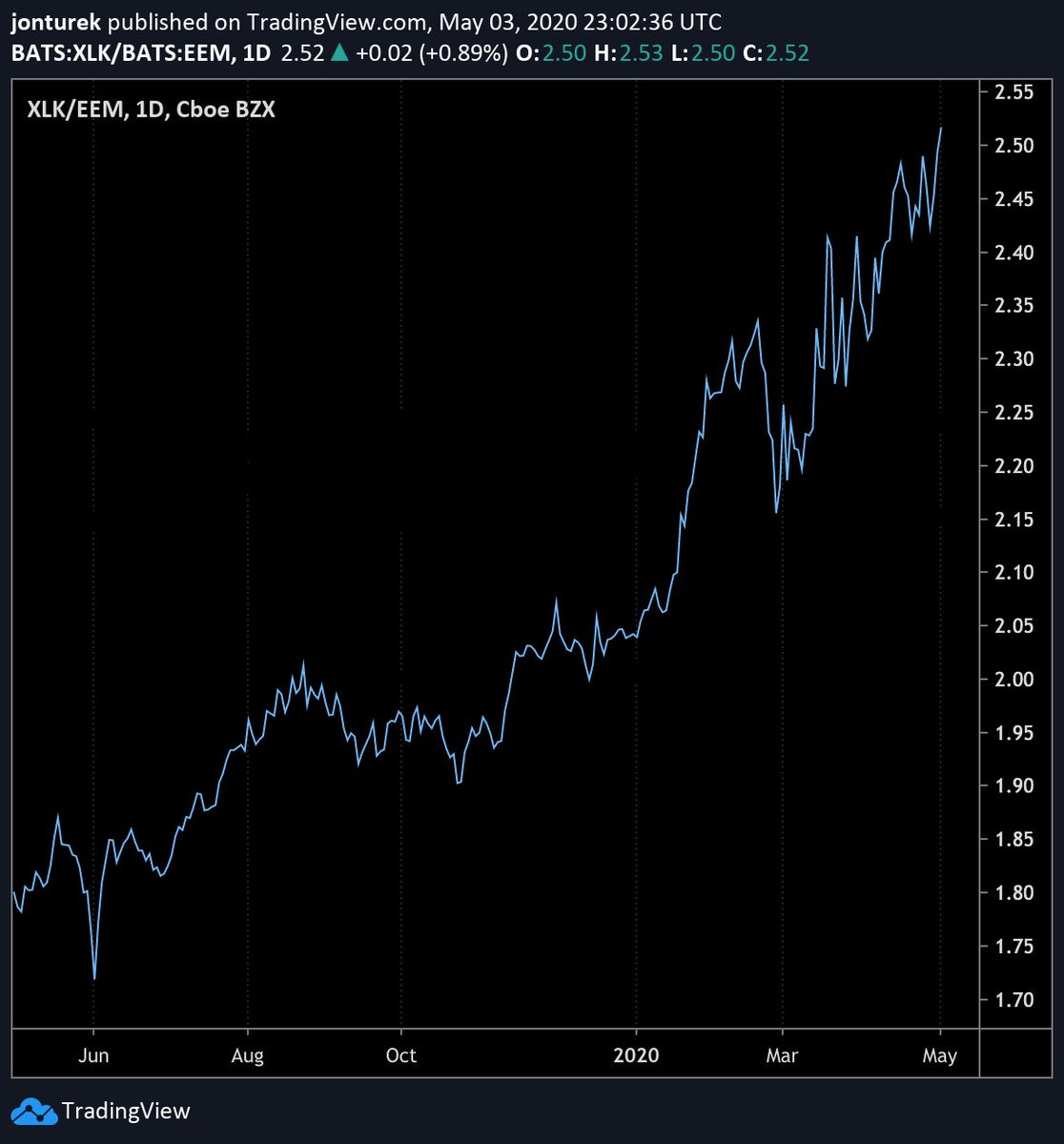
Overall: The combination of this dynamic, how economically regressive covid is, i.e. the poorer countries are more vulnerable, has set up this really interesting dynamic. My expression for this framework has been long tech short EM, or on twitter what I called the "cleanest chart in macro." The reality is, it plays on so many macro dynamics, from relative balance sheet capacity, distribution of economic outcomes, and capital flows in a global QE world.

Said in another way, I want be long "good" outcomes in US equities and "bad" outcomes in EMFX.

Tech v EM

Image

The other way I have been thinking about this framework is, being short reflation and being long the market is not at odds with each other. 


The European barbell, politics is a left tail

I have written a lot about a European barbell, an idea basically that Europe is at a key point and it basically has two options.

Two options:

1) The good one: some level of joint issuance either via mutualization or through commission bonds that allows for risk sharing among members. This would not only be crucial in terms of politics and solidarity but it would also provide the world a safe asset in a time of high demand for cash alternatives. This would be bullish EUR.

2) The not good outcome is, the northern countries don’t budge on some level of risk sharing and despite an aggressive ECB and a real backstop in the ESM, political backlash leads to fragmentation that the ECB will have a tricky time combatting. The point is, technicals aside, even with unconditionality, eurobonds and ESM are not interchangeable from a political perspective.

A muddle through might not work, the South has leverage this time

Another new dynamic this time is, the Italians have power and what if Italy throws a punch.

The creditor v debtor dynamic has changed, the periphery is no longer the "bad guy", that’s now the Northern countries and they don’t seem to get it. An exogenous shock has rocked the southern countries, one the Commission admitted to being late to, this isn't a situation where another round fiscal responsibility lectures will go over well.

This is a problem the market seems to be discounting. Of course within the distribution, the most likely outcome is some form of European muddle, as we have seen so far with the Commission recovery fund that does propose some grants. However, the difference this time is, not that a muddle wont work, but it may have tangibly negative political repercussions, and relatively soon. The political terms seem a lot more binary.

Mutualization type = support and solidarity, ESM type even with unconditionality = you don't care.

If Conte is going to try and sell the people on another classic pathchwork European backstop, this sets up a worrying development. Either the Italian government decide they do not want to sell this or they do and it is rejected via domestic political turmoil. I.e. if a bandaid is the European response, it could get pulled off pretty quickly.

The question is, how do you bet on unfortunate outcomes in Europe. The currency is tricky because that surplus is such a floor in risk off. Despite asymmetry, BTPs are hard to short given the ECB bazooka with PEPP, that will likely get bigger. Sure Lagarde left a lot to be desired last week. but the ECB is there to tighten spreads and the market knows it. So there are two dynamics, there is a tail in Europe that is still likely underpriced, but given structural dynamics within the EMU (current account and APP) its not clean to bet it. The answer may be short CEE FX, short EMU beta.

CHFPLN daily chart (LHS). GBPCZK monthly with 5y moving average (RHS).


Central European economies face a very precarious future, especially if the EMU is going to muddle through this. What is the CEE model. They get trade and funds from EU, it eats up domestic slack (tight immigration), raised rates relative to EMU (CZK), carry etc leads to recycling. The problem now is, the export car parts to Germany so that they can export cars to China, is not an ideal economic model. Since 2002, Poland/Czech/Hungary, have seen their nominal export levels rise by 2-4.2x. Integration has been a great trade for CEE.

As these globalization and global trade tailwinds have transitioned into headwinds, these currencies have to get fundamentally cheaper. And this all before their respective local political situations.


UK v Europe, long policy flexibility and short policy constraints.

I wrote last time why GBP is an interesting story. In theory, when UK eases, GBP gets killed because of current account, external debt etc. This time around, GBP has stayed relatively bid, even with one of the more aggressive monetary/fiscal mixes. The thesis I presented last time was that the market could be “rewarding” the UK for being less constrained than say Europe, which gives it a sort of 1931 feel in terms of the UK breaking free of policy constraints.

UK stocks v France (EWQ) & Italy (EWI), some interesting weekly moving averages.


Yen with a Fed backstop, a "free" claim on US assets.

There are a few interesting dynamics within JPY right now:

1) The Fed helped out GPIF. Dollar liquidity has allowed to them fund/hedge and Fed's backstop of IG has protected their positions. Fed will keep bills-ois in tact and try and prevent it from spilling into unsecured markets. This has been the pressure point for Yen and the Fed is on top of it. As long as BoJ is getting liquidity to end users, the pension/lifer sector, JPY should avoid another flare up.

2) Without technical dislocations in FX swap market, is Japan's NIIP position just a "risk free" claim on US asset prices. Now, especially if the Fed does YCC, why would GPIF take more naked FX risk unless instructed to do so by the BoJ (stealth intervention).

3) Everyone is at lower bound, Japanese FX policy from MoF/BoJ was not designed for that.

The question for Japan now is, how do they weaken Yen. The original catalyst for Yen weakness into this crisis was, Japanese bank and non bank sectors have a ton of dollar funding needs, which has explained the massive BoJ take up of the Fed's swap line. But, given how interest rates everywhere have converged to zero and deflationary risks from the demand shock have lowered expected inflation, it is very hard for JPY to weaken.

Yen v surplus Asia could be an interesting dynamic, sort of a lag trade at this point. As we have documented, a lot of surplus Asia is similar to Japan in a NIIP sense. They have a ton of excess savings that overwhelms size of domestic market so needs to be exported. However, unlike Japan, none of these countries have made the painful export adjustment (Japan is still in it). Exports accounting for 50% of GDP is not the way of the future. So many of these Asian countries are in for an adjustment, likely a fiscal one. So yes, both Japan and surplus Asia have massive NIIP positions which should support FX valuations, but relative to Japan, many of them still have to make broader economic adjustments.

This chart is super interesting. JPYKRW.


Does the Phillips Curve matter if income has been replaced?

This is a bit wonky but it fits into my framework for that reflation and rising asset prices are not the same thing. The question is, why has deflation been ruled out.

Few potential reasons:

1) Even if the Phillips Curve is alive, the income channel has been replaced via stimulus. Goldman did a great chart documenting that as a first order shock absorber to spending, stimulus has prevented a disaster in incomes.

2) It didn't happen in 2009. The new Keynesian model told to us to look through current slack. Future marginal costs matter more than current economic activity. I.e. there is this form of discounting which leads to stickiness. And that is why the a DSGE based on NKPC would not have forecasted deflation post GFC.

3) The most accepted reason in policy maker circles is, the flatness comes from a lack of variance in inflation given how successful monetary policy has been in anchoring expectations.

4) the price PC slope has flattened because both wages and prices are changed less often. Once variance decreases, stickiness increases and the response to changing labor market dynamics is smaller.

5) Empirical bias. As the unemployment rate got lower and lower, and past any SEP estimate of NAIRU, the conclusion from policy makers was, the price PC still lives, but the slope is just much flatter than we assumed.

What if policy makers are too confident the PC is dead or irrelevant given income replacement.....

Yes, a lack of variance in prices seemingly has become self fulfilling. But there seems to remain risks that we buried the Phillips Curve at the wrong time. Maybe, it's not dead, maybe it's just asymmetric. And yes, income has largely been replaced by stimulus this time around. But, there is still a lot of behavioral differences between someone who is employed v unemployed. Healthcare, risk aversion, expectations. I.e. you can replace income, but the impulse is fundamentally different.

This a rough example where you take average PC slope during two "best" years of recovery v two "worst" years of downturn. Plenty of problems with this approach, but does convey an interesting point that should be pretty intuitive. Of course, in these episodes the fiscal stabilizers were nowhere near as big as they are today.


This is why I am surprised the Fed has been relatively slow in changing its forward guidance that is far too delphic v ZLB risks. The current idea seems to be it is too early and the Fed at this point doesn't need to convince the market of much.

I think the right framework for where the Fed is going in this regard comes from Brainard's February speech. Her idea is that we should have aggressive outcome based forward guidance along with interest rate caps, creating what Brainard calls, "the commitment mechanism." This is really interesting because both of these policies have merit on their own, especially at the ZLB, but together, they kill two birds with one stone. Cap yields, strong odyssean guidance, and together they reinforce each-other. I think this the framework the Fed will adapt, whether at June SEP or Jackson Hole, but sooner than later.